

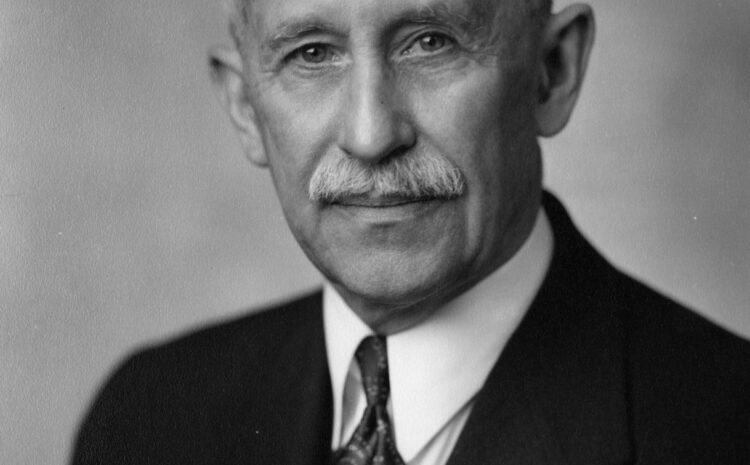
Orville Wright’s surprising final patent
The story of Orville Wright has long been the stuff of folklore. At a time when flight was considered impossible, Orville and his older brother, Wilbur, invented the airplane in their West Dayton bicycle shop. Up to that point, unsuccessful attempts had occurred, time and again, by experts of far greater means and formal education. (Wilbur never picked up his high school graduation certificate and Orville dropped out before his senior year).
The Wrights brothers’ unlikely ascent is a tremendous tale, one that could have kept Orville in the spotlight his entire life. But while the world’s first pilot would inevitably enter the annals of history, he had no flavor for public attention, nor was he compelled to further prove himself. As complex and brilliant as he was, at his core Orville was a humble inventor from Dayton, Ohio, content to live out his days surrounded by family, tinkering—forever creative—on his own terms.
Orville Wright’s final patent was not for some grand innovation, nor some aeronautical breakthrough, but a child’s toy that launched a small wooden clown acrobat through the air to swing from a trapeze. The world’s first pilot’s last patent was for Flips and Flops.
“On one end, it had a springboard that could be put under tension and then be released by a trigger,” Orville’s niece, Ivonette Wright Miller, told Tom Crouch, author of The Bishop’s Boys: A Life of Wilbur and Orville Wright. “It had a launching seat on it and a little wooden clown with wire hooks for arms.”
The idea for Flips and Flops was conceived at a Wright family Christmas dinner in 1923. Orville’s nephews and nieces, grown and with their own children, gathered at Hawthorn Hill, marveling at a toy he enjoyed as a boy. Harold Miller, the husband of Orville’s niece Ivonette, observed with intrigue. As the owner of The Miami Wood Specialty Company, a novelty manufacturer, Harold approached Orville about producing a similar toy for his business. Orville got to work, and on January 25, 1925, he was awarded U.S. Patent No. 1,523,989 for Flips and Flops—his final patent before he died on January 30, 1948, at Miami Valley Hospital in Dayton.
Richard C. Cummings, a volunteer at Carillon Historical Park, interviewed Ivonette Wright Miller for his book, The History of Dayton Ohio Toy Makers. She recalled, “Harold brought the acrobats for the Flips and Flops toy home for the women to paint.” Cummings notes that Ivonette was obviously one of them.
Ivonette also gifted Cummings an original Flips and Flops, now on permanent display alongside numerous other Dayton toys at Carillon Historical Park. Written on a panel above the elaborate display case are the fitting words: “We are a part of all we have met.”
