

Outside the classroom, CJ students pursue excellence in science, technology, engineering, math and medicine programs
Taking a cue from its local employer base, Chaminade Julienne Catholic High School (CJ) helps students focus on the Dayton region’s focus in the fields of science, technology, engineering, math and medicine via its CJ STEMM program. Collaboration with area professionals, businesses, colleges and universities, shepherded by CJ STEMM Coordinator Meg Draeger, has allowed for evolving opportunities for students in and outside of the classroom.
“CJ STEMM inspires students to explore the world of STEMM, and then help them discover and grow their own talents and passion related to the fields of science, technology, engineering, math and medicine,” Draeger says. “We support the academic success of students and encourage them on their path to becoming future advocates, professionals and educators.”
The CJ STEMM Center, which opened in 2013, facilitates collaboration and offers nationally certified courses for engineering and biomedical sciences. Students can work at the level, pace and style of college learning and can receive college credit. Recently, a few students have pushed the limits through their involvement with innovative projects.
Flying High
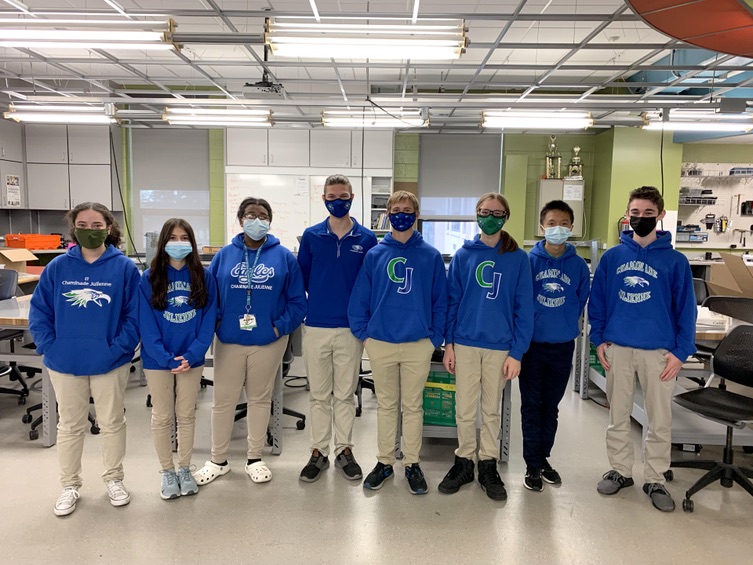
Outside the classroom, CJ students are reaching new heights—literally. In the fall, CJ’s Robotics team participated in the For Inspiration and Recognition of Science and Technology (FIRST) competition. FIRST is a robotics community that prepares young people for the future through a suite of inclusive, team-based robotics programs for ages 4-18 (PreK-12) that can be facilitated in school or in structured afterschool programs.
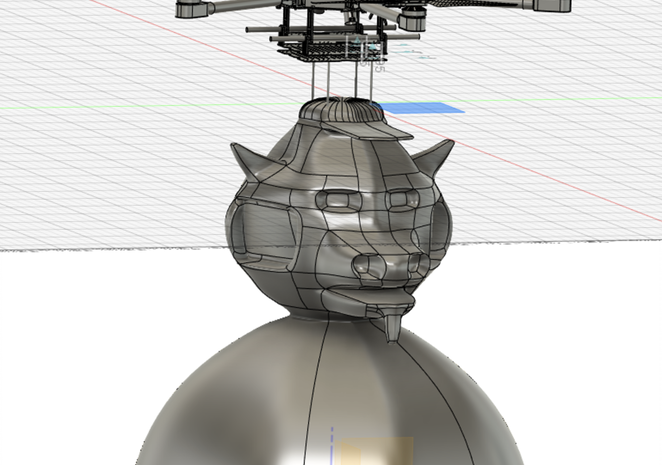
Led by club moderators Chengkun Liu and Anna Sitz, the students sought to give the mascot of Dayton Dragons professional baseball team, Heater, the ability to fly like a dragon. The competition is broken down into multiple stages: design, selection/fabrication and demonstration. In the design stage, teams determine attachment points to the drone, materials needed for each part, and provide a detailed CAD drawing. The students submitted their initial design for the “Make Heater Fly Challenge” and were one of only five designs selected to proceed to the fabrication phase. They then delivered the finished products for a demonstration.
The team received financial resources for their design submission and for fabrication costs, then worked with judges to receive feedback on their design and work to complete their project. They’ll also receive support from the Air Force Research Laboratory (AFRL), the FIRST Robotics League and the Wright Brothers Institute (WBI).
It’s not just the thrill of the competition itself that makes this project exciting. “This challenge gave our robotics club students an opportunity to expand their skill set into modeling and design,” Sitz says. “Working with an aerodynamic system was a unique challenge as well. The robots our students work with are all land-based; they aren’t used to working with flying drones. The feedback we have been given from the panelists was also a great learning opportunity for them, as they got to hear critiques and suggestions from experts in the field of how to improve the design.”
Win or lose, the students gain valuable insight into working on a team and problem-solving in a STEMM setting—all important skills they’ll lean on after graduation regardless of where their paths take them. Maveric Clausing-Koeppe says goal setting was an aspect of the project that was particularly enjoyable. “My favorite part has been thinking of the end project,” says Clausing-Koeppe, a senior at CJ. “Taking these complex equations, equipment, and pieces and picturing it in the sky at the stadium has been a lot of fun.”
Sitz agrees. “Overall, I’m very proud of our students,” she says. “Not only was it a unique and fun challenge for the students to participate in, but I’m very glad they got to experience the design refinement and fabrication side of the project as well. I think it will be very valuable life experience regardless of what field they decide to pursue in their future, and a great resume booster!”
“At this time, we are hopeful for the outcome,” says Chengkum Liu, CJ teacher and club moderator. “Should we win, the fabrication of Heater will take a couple of weeks. We would partner with a local company, Bastech, who would help us with the fabrication. The first flight test for the prototype would be in early January.”
The Next Step
The robotics team aren’t the only Eagles seeking extracurricular accolades. Senior Ja’Brina Hargrave-Perkins was recently invited to participate in the National Society of High School Scholars annual Scholars Day event to present her invention.
In November, Hargrave-Perkins and 14 other students from around the globe converged on Atlanta for a two-day educational conference, featuring several workshops, a college and career fair, and networking opportunities.
One of Hargrave-Perkins’ science teachers, Amanda Ooten, lauded her student’s accomplishment. “Ja’Brina is a true example of a self-starter who thinks outside of the box,” Ooten says. “She was one of only 15 top applicants who were invited to the live finals in Atlanta.”
Treading in the footsteps of other Dayton-born engineering greats, Hargrave-Perkins’ invention, The Energy Step, addresses the problems of renewable energy production. During the year 2020, in the United States, approximately 17,261 trillion btu (British Thermal Unit) of energy was consumed and of this only 12.4% (2,140 trillion btu) was renewable. The other 87.6% of energy consumption came from non-renewable fossil fuels like coal, oil or natural gas.
“These energy sources are declining in abundance and have negative effects on our environment,” Hargrave-Perkins says. “My invention, the Energy Step, produces energy at the single step of a foot and stores this energy into a battery for later use. The Energy Step is a platform that is embedded into the sidewalk. The yield of one step is small—insignificant even. But the combined impact of hundreds, thousands or millions of steps is extraordinary and very significant. With the Energy Step, we could literally change the world one step at a time.”
Hargrave-Perkins says she was inspired to create pedestrian-powered sidewalks by observing how bicycles can transfer and store energy. “I wondered if you could turn that pedal into a simple step,” she says. “I contacted the engineering department of our school and went on from there.”
The Scholars Day event was priceless for Hargrave-Perkins, who says she plans to study engineering or biology in college. “This was such a great experience and also a wonderful networking opportunity,” she says. “I was able to speak about The Energy Step with CEOs from many major US companies, representatives from the federal government and representatives from the Armed Forces. These conversations not only provided real validation of my work, but also provided me with numerous contacts and solid advice on moving to the next phase with my invention.”
