

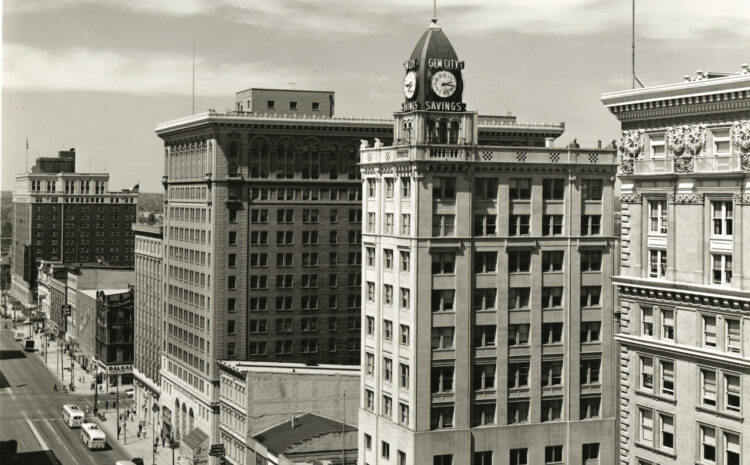
The Callahan Clock, Dayton’s iconic timepiece, now sits atop the Brethen Tower
Driving down Interstate 75, near Welcome Stadium, just south of a dogleg bend in the Great Miami River, a 135-foot-tall clock tower rises from a nearby hillside. During warmer months, the tip of the tower, bright blue, is hemmed in by the bright green leaves of the nearby oak and elm and maple trees, ticking time as motorists travel across the heart of America. The words “Carillon Park” stretch across the clock face in bold and bright white letters.
Since the clock tower, now known as the Brethen Tower, was dedicated at Carillon Historical Park in October 2018, the timepiece has become synonymous with the 65-acre open-air museum. But for years, the clock, once known as the Callahan Clock, topped the Callahan Building—the centerpiece of a bustling downtown.
The Callahan Building, built by William P. Callahan, a prominent banker, manufacturer and Irish immigrant, was sometimes referred to as Dayton’s first skyscraper. With its Swiss-crafted wooden inner workings (which were wound weekly), the Callahan Clock was the crown jewel of its namesake building, welcoming countless Daytonians through its doors, including a 19-year-old African American poet. In 1891, Paul Laurence Dunbar, the nation’s first professional Black writer, worked as the Callahan Building’s elevator operator.
“Between elevator calls Paul read or wrote, composing poetry and short stories,” wrote Ann Honious, a former ranger with Dayton Aviation Heritage National Historical Park, in her book What Dreams We Have. “He was often seen perched on his stool in the elevator surrounded by books and papers.”
Initially, the Callahan Building housed the City Trust and Savings Bank, the words “City Bank” installed across the giant tiled clock tower. But by the 1920s, Gem City Savings Co. took control of the building, refurbished the clock, and added the words “Gem City Savings” to the facade, earning the timepiece a new nickname: the Gem City clock. For decades, Dayton’s iconic clock towered over Third and Main streets, the heart of downtown, but by 1978, a new building, one designed by legendary architect I.M. Pei, was set to replace the Callahan Building, and the historic clock was in peril.
With the future of the Callahan Clock uncertain, Dayton company Reynolds & Reynolds, which was founded in 1866, decided to save the timepiece, installing the words “since 1866” above the clock face, then hoisting it atop its company headquarters on I-75. For 28 years, motorists across the country drove by Dayton’s famous clock, sealing its place as a symbol of the Gem City. But in 2006, when Reynolds moved its headquarters, the Callahan Clock was once again in danger. And that’s how it landed at Carillon Historical Park.
Saving the Clock
In 2005, Carillon Historical Park and the Montgomery County Historical Society merged to form Dayton History, Montgomery County’s official historical organization. The following year, the newly formed nonprofit decided to, once more, save the Callahan Clock. On a drizzly November day, a Dayton Police Department detail escorted the timepiece across the Stewart Street bridge, as two forklifts—one driving forward, one driving backward—carried the clock to its new home at Carillon Historical Park. After three moves in its 87-year history, the Callahan Clock finally found a permanent home at Carillon Park.
The Brethen Tower and Beyond
When the Callahan Clock arrived at Carillon Historical Park, Dayton History President and CEO Brady Kress decided to return the iconic Dayton symbol back to the city skyline. Today, visitors can climb the grand tower to a viewing platform roughly 100 feet in the air, providing a bird’s eye view of Carillon Park’s 65-acre campus. Through a series of educational panels, they can learn about the clock’s long history and, through carefully placed tower viewers, they can glimpse the bald eagles nested in a sycamore tree, high above the Wright Brothers National Museum. But that’s not all.
Alongside the clock tower, Dayton History is currently constructing a working railway station, the hub of the forthcoming Carillon Historical Park rail line. Visitors to Carillon Park this summer will notice the construction, which should be completed by year’s end, just in time for A Carillon Christmas, the nonprofit’s month-long holiday celebration.
“Everybody can get on any time of the year and ride around the park,” Kress told the Dayton Daily News. “The rail line—with a ‘Western boarding station’—is an integral part of the [master] plan.”
