

Dayton Public Schools prepares students for college and careers at Ponitz Career Technology Center
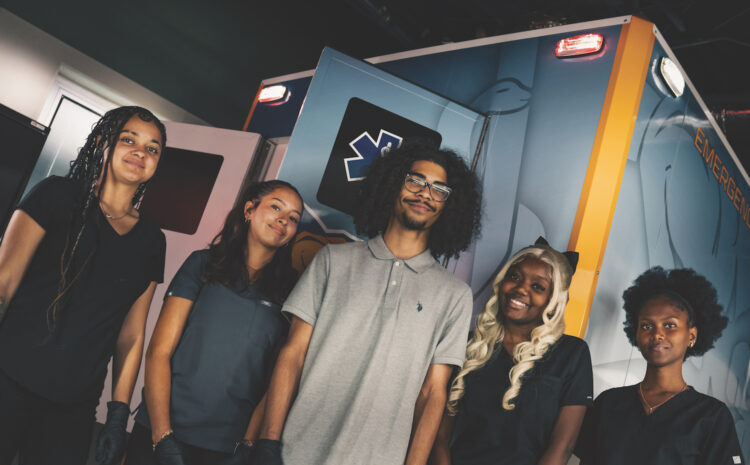
This year, when students enter the Emergency Medical Technician (EMT) program classroom in Ponitz Career Technology Center each day, they’ll find more than desks and chairs—they’ll also a life-size ambulance simulator. According to the company that provided it, Ponitz is the only high school that has this equipment.
“[Dayton] Children’s Hospital has it, but it’s for professionals. Our kids couldn’t get to that. And then Sinclair has something, but it does not move. It’s just stationary. We are state of the art. It is phenomenal piece of equipment,” says Matt Kerth, director of Career Tech for Dayton Public Schools. He oversees all career tech education (CTE) programming at DPS’ two dedicated career tech centers, Ponitz and Meadowdale, as well as the CTE programming that’s expanded into other non-CTE schools and middle schools.
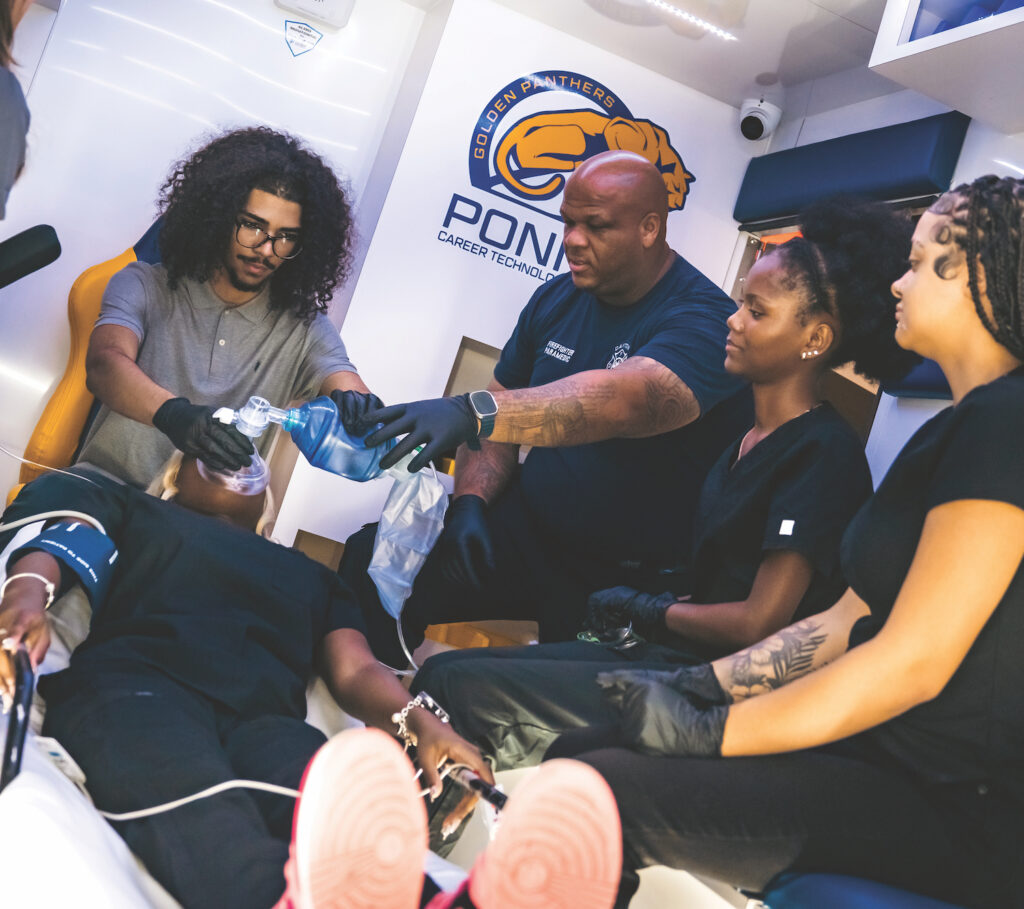
The ambulance simulator, installed this past summer, gives students a more realistic taste of what it would be like to work in an ambulance.
“I want to give these kids a real-world working environment because it’s not a lot of space,” says Troy Shropshire, EMT program instructor and professional firefighter and paramedic for the city of Dayton. “Once you put a gurney back there, you get two or three people back there, you’re limited on movement, which is why you have to learn to communicate with one another. Hey, can you hand me this? Or can you do this while I do this? And you just learn the teamwork aspect of it. And that was pretty much the main goal was to give the kids the most realistic work environment possible, from space down to even the equipment that we ordered and that we stocked in there. It’s real-world equipment.”
In addition, the simulator is also on what Kerth calls airbags, which allow Shropshire to give students the experience of working on an ambulance as its drives.
“The teacher has a separate room where he can see everything that’s going on with the four different cameras in the ambulance. And he’s able to talk to ‘em while he’s using joysticks to simulate going down the road,” says Kerth. “He could make it as simple as going down just a well-paved road or he could make it like you’re going down Salem Avenue. … So now students are allowed to take the skills that they’re learning in the classroom and apply it on the simulator and learn how to take blood pressure, learn how to do the different things that they are needing to do to get the EMT license that they couldn’t get unless they were on an actual ambulance.”
The new ambulance simulator is just one way Ponitz Career Technology Center is helping students prepare for life after school. “I think what makes the EMT or any career tech program beneficial or so desirable is we look at the options for our students. No one particular program is geared towards one particular track. So EMT, you could go straight to the workforce, you could go straight to college. We push both. There’s a lot of college credits in all of our classes, either through [College Credit Plus (CCP)] or through [Career-Technical Assurance Guides (CTAGS)], which is what states have for career tech programs. So there’s a benefit there,” says Kerth.
Unlike students who go to a career center—in which they take classes at both the career center and their home high school—Students who choose career tech at DPS take all their classes, from English and math to EMT and cosmetology (depending on their pathway), at the same school. The high schools have students in ninth through 12th grade, and even offer typical high school activities like sports.
This format enables instructors like Shropshire to impart necessary skills such as CPR certifications, fire education and hands-on clinical skills, but also life skills students can carry with them, regardless of their career.
“I also try to teach my kids life lessons and skills, things like how to deal with mental health. Just building healthy habits and learning to cope and things like that,” he says.
Carmen Carmona, a senior at Ponitz in the EMT program, agrees that she’s also learned valuable life skills.
“We change our mindset in here. We think about things differently while we’re in here and we can take that into the outside world with us. We have to be calm under pressure, just stuff like that,” she says.
Carmona, who plans to work as an EMT while going to college for nursing after high school, believes the program is setting her up for success.
“I think it gives you a step up [in the future], definitely. You’re going in with a better knowledge than somebody that would just go to a regular high school,” she says. “We’re learning stuff that people actually learn when they go in to get their EMT certification in real life. Ours is just more spread out. Honestly, I feel like we get more of an advantage because we get more time on it and a one-on-one teacher.”
The EMT program, which was created last year, has already proven to be popular, with the class meeting max capacity both years. Students who graduate earn their state EMT certification, American Heart Association CPR certification and industry credentials like NIMS (National Incident Management System).
And Kerth is excited for what’s next for the EMT program, as well as the other pathways, such as allied health, automotive, biotechnology, business finance, construction, cosmetology, criminal justice, culinary arts, dental assisting, engineering, graphic arts and design, media arts and pharmacy technician.
“Career tech isn’t the old career tech, the old vocational model. The old vocational model was come here, learn a little bit and get out to work. It was always seen as for students who don’t do school well,” he says. “Career tech is very different now. We are for career and college readiness. We’re getting our kids ready for the next step. It’s a different way to think about education. It’s a hands-on model as opposed to the traditional sitting there learning and regurgitating that knowledge back. Our kids are hands on. They are actually meeting the industry professionals. They’re building a social network while in school.”
