

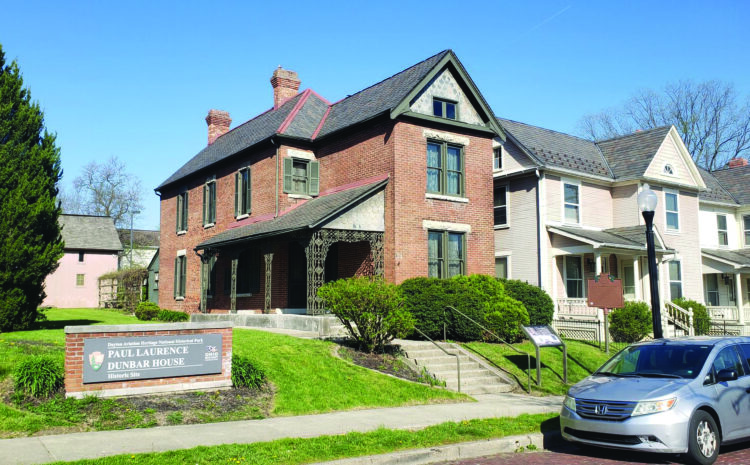
After a $700,000 renovation, the Paul Laurence Dunbar House reopens its doors—and its story
The Paul Laurence Dunbar House has stood in memorial to the late poet Paul Laurence Dunbar since it opened to the public in 1983. While its historic nature has remained intact, time has taken its toll on the building. Like many older houses, the Dunbar House was in need of repairs. Ohio History Connection, which cares for and maintains the home, recently finished a $700,000 restoration of the Dunbar House. In May, the house reopened to the public, telling the story of Dunbar to visitors once again.
Paul Laurence Dunbar is considered to be one of America’s greatest poets and an important figure in African American history. He authored hundreds of poems and several novels, short stories and song lyrics. Through his literature and poetry Dunbar became a powerful voice for equality for African Americans.
Visitors can find many relics from Dunbar’s life preserved in the house. A bike thought to be purchased from the Wright Brothers’ shop, literary items, collected art and more personal belongings can all be found in there. Visitors can also find an on-site visitor center detailing the story of Paul Laurence Dunbar’s life.
After many years on display, the Dunbar House was due for some restoration. Restorative efforts were focused on structural repairs to the masonry, drainage and grading, and stabilization to the foundation as well as some aesthetic repairs like painting.
“With restoration and even construction work, if we’ve done our job right, you are going to notice it looks better, but most people won’t notice the extent of what we did. It’s the hidden details. Most people just walk because it’s done right,” says Sarah Vandenbark, staff architect at the Ohio History Connection.
Nonetheless, historic restoration is not without its challenges. In order to properly restore the house, the team needed to find historically accurate matching bricks. This task took several months and many visits to buildings set to be demolished. Eventually, they were able to find a match in an old trolley building.
“You absolutely cannot tell where the replaced bricks are. They were an absolutely perfect match.,” says Chris Buchanan, historic project manager at the Ohio Historical Society.
Luckily, the team at Ohio History Connection was able to follow a path unknowingly laid by the poet’s mother.
“In the case of Dunbar, we’re really fortunate in that it basically is a time capsule. His mom kind of left it as a time capsule so that we don’t really have to worry there so much about what is or is not historic. A lot of that work has happened in the past, and now our jobs today are more like stewards trying to keep that,” says Buchanan.
In order to preserve a little bit of history and inform future architects and historians, the team left behind a small area of the original building.
“You always try to leave, to try to identify an area that you can leave the original in place as sort of like a time capsule or record, even with paint. Even if you strip paint, you always try to leave a little bit behind on strips so that future generations can see and understand what you did and why you did it,” says Buchanan.
