

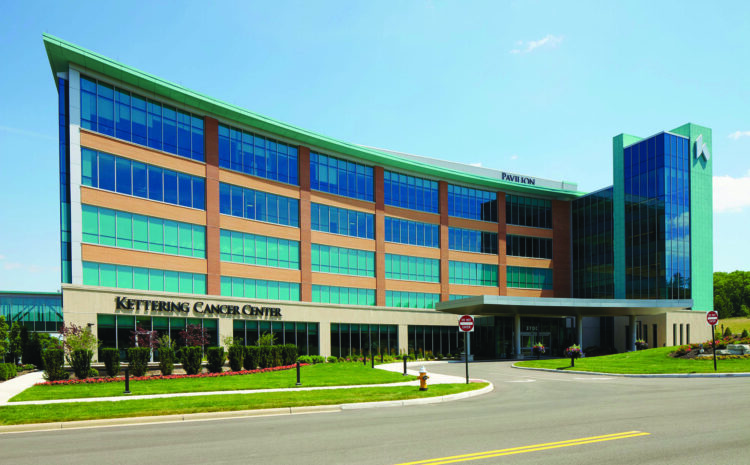
Kettering Health partners on revolutionary cancer care strategies
For any health care organization, growth can take many forms. It can mean growth of facilities or geographic footprint. It can mean growth of patient and provider populations. Or it can mean growth of the level of care and its outreach into the community. Like any other organization, if you are not growing, you are falling behind. That is especially true when you are dealing with the accelerating nature of the detection, discovery and treatment of cancer in the human body, which is changing on an almost daily basis.
As a world-class cancer care organization serving Southwest Ohio, no one knows that better than the Kettering Health Cancer Care. With locations in Troy, Beavercreek at Soin Medical Center, the Kettering Health Main campus and Kettering Hamilton in the northern suburbs of Cincinnati, Kettering Health Cancer Care is uniquely positioned to make its services easily accessible.
“And there is a fully integrated cancer center at each of those four locations,” says Kenneth Chaij, executive director of oncology at Kettering Health. “However, in terms of other metrics, we have been in a growth mode over the past 12 to 18 months.”

Patient population across the four centers has grown by more than one-third in that time, says Chaij, with Kettering seeing both an increased number of patients from the communities it serves as well as attracting new patients from outside our area.
To meet those increasing needs, Kettering has added to its cancer care staff, which now has a total of eight radiation oncologists and four medical oncologists on staff.
Perhaps even more importantly, Kettering is changing the way it now addresses those challenges using the newest, revolutionary forms of cancer care that provide for earlier detection, discovery and treatment of the deadly disease.
Market dynamics and increased marketing and awareness efforts have created something of an upheaval in the Dayton and Greater Miami Valley areas with Kettering being a benefactor of that growth. Yet despite an increase in patient volume, “we are still seeing patients coming to us with more advanced cancers,” says Chaij. “They may have put off getting screenings done, or sometimes even put off their annual visit to a physician, but it really pulls at your heart strings because we are seeing more people under the age of 40 who are coming to us with advanced cancers. And at that point, our options are often limited.”
Which is the primary reason that Kettering has redoubled and refocused its efforts on discovery and detection.
“Our desire, from our medical directors all the way down through the ranks of our physicians, support staff and other health care providers such as nurse practitioners, is to try and move the discovery of cancer to earlier and earlier stages of the disease,” says Chaij. “Instead of seeing cancer at late Stage III or Stage IV we want to catch cancer at Stage I or Stage II.”
Or even before. Partnering with its primary care physicians and OB-GYN doctors, Kettering’s goal is get cancer detected through testing, screening and getting imaging done.
“If we can catch cancer when it is very small, the type of treatment therapy that needs to be performed is often much less invasive,” adds Chaij. “You also have a much better outlook on life in terms of not only your survivability but also the quality of life.”
This shift toward earlier detection and discovery of cancer fits with a national health trend toward better community health, says Chaij. It also opens the door wider for new and innovative therapies, some of which can be used to manage cancer at the molecular level—which represents the cutting edge of cancer care. Today, a simple blood test done at a primary care physician’s office can sometimes detect multiple cancers, or the potential for cancers, in a patient’s blood stream.
“And those tests exist today,” says Chaij. “There is one that can literally detect up to 50 different cancers and it can tell you the stage of the cancer as well. That changes our entire conversation when it comes to asking what we can do for our patients.”
It is also the reason that Kettering is not only partnering with its primary care physicians, but also outside laboratories like Invitae and Myriad Genetics, whose genetic tests help caregivers gain a clearer understanding of a patient’s chances of developing hereditary cancer.
“Our mission is to partner at the primary care level so that genetic testing can be incorporated and done very easily,” adds Chaij. “These tests help us catch things early or may even allow us to tell someone who doesn’t have cancer that they may be at risk for it because they have certain mutations. They might not even need treatment. But it will allow us to monitor them, to tell them they need to come back for a mammogram, breast ultrasound and MRI or whatever it may be. That way, if we monitor them, we will be able to catch it very quickly.”

Performing early screening and genetic testing provides something of a benchmark, a lifetime risk score that tells you when a patient needs observation and monitoring, so that they can survive, sometimes for decades into the future.
“We also have people who can talk with you before the test is performed, like genetic counselors,” says Chaij. “Then afterwards when the results come in, we can share that with your primary doctor so they can help you make an informed decision on your next steps.
“It’s not enough for us to simply say, ‘We have tested you and now you have that information, goodbye.’ We also have an ethical duty to help them with their next steps,” Chaij adds. “We need to help them in dealing with treatment or therapy. We may need to help them offset the financial impact on their family. Or we need to help them if they get depressed.”
With the myriad and constantly evolving cancer treatments coming online, Kettering Health Cancer Care is still committed to the traditional treatments.
“But the new procedures and treatments have forced us to refocus on accelerating the detection and discovery of cancer,” says Chaij. “That way our patients are afforded better access to the many available options of cancer treatment today.”
