

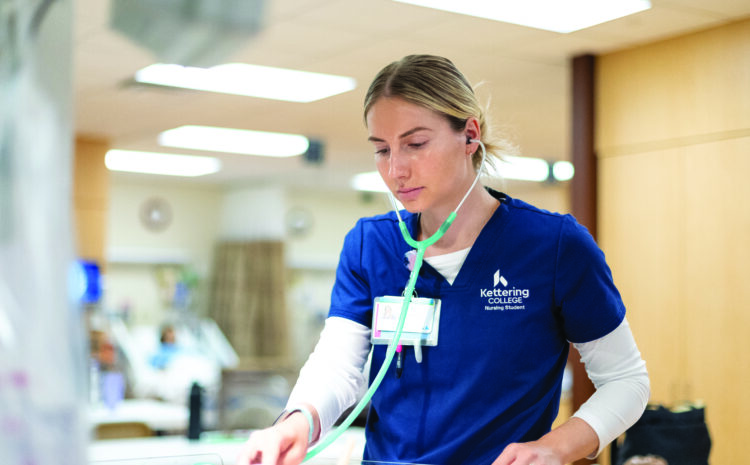
Kettering College teaches students about all kinds of care
Looking for a career change? Kettering College offers associate or bachelor’s degrees in a variety of health care fields, including nursing, radiology, sonography and respiratory care, as well as a doctorate in occupational therapy. Many of those programs are populated by nontraditional students in their mid to late 20s.
This year, the college will enroll the first students in its nursing master’s program, where students with an undergraduate degree in nursing can pursue a Master of Science (MSN). Once completing their MSN, students have the option to continue and pursue a Doctor of Nursing Practice (DNP) degree.
The college’s faculty combine clinical expertise with “tremendously” impressive educational skills, says Nate Brandstater, president of Kettering College.
“Our faculty have just a terrific blend of clinical and discipline expertise,” he says. “Almost all of our faculty developed experience in their disciplines as clinical professionals before making that transition.”
By creating accredited, qualified health care workers, Kettering College serves its students, the region and Kettering Health—which hires a significant percentage of Kettering College graduates each year and owns the college. Brandstater sees the college as a huge asset for the region and its health care system.
“I want for leadership at Kettering Health 25 years from now to be significantly populated by Kettering College alumni,” Brandstater says. “And Kettering Health shares that value.”
Community Care
In December, Kettering College graduated its first cohort of certified community health workers. A relatively new classification, community health workers are grassroots health workers who can act as liaisons among medical professionals, social workers and patients.
Community health workers have a better understanding of the communities they serve because they actually live in those communities, Brandstater says.
“They understand the challenges that the individuals in their community face—not only in accessing health care itself, but in accessing the community resources that promote healthy lifestyles and healthy outcomes,” he says.
The college’s community health worker certificate program is funded by a grant from the federal government, so anyone accepted into the 14-week evening class program can complete it free of charge.
Spiritual Care
Kettering College is a faith-based institution, chartered by the Seventh-day Adventist Church, and aims to teach students about the spiritual aspect of caring for patients as well. (For students particularly interested in developing their skills in this area, the school recently introduced a minor in spiritual care.)
Patients experiencing major medical episodes often have cause to think about their spiritual lives, Brandstater says—and it’s crucial that health care providers be prepared to help those patients with all aspects of their struggles.
“That aspect of our identity really just oozes into everything we do,” Brandstater says. “There is a genuine skill set that comes with spiritual care, just like there’s a skill set that comes with clinical care, physical care and mental care.”
