

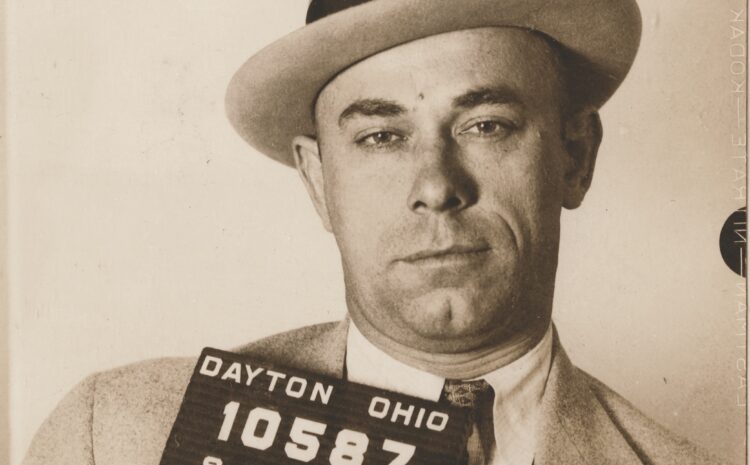
The nation’s first Public Enemy No. 1 was arrested in Dayton on Sep. 22, 1933
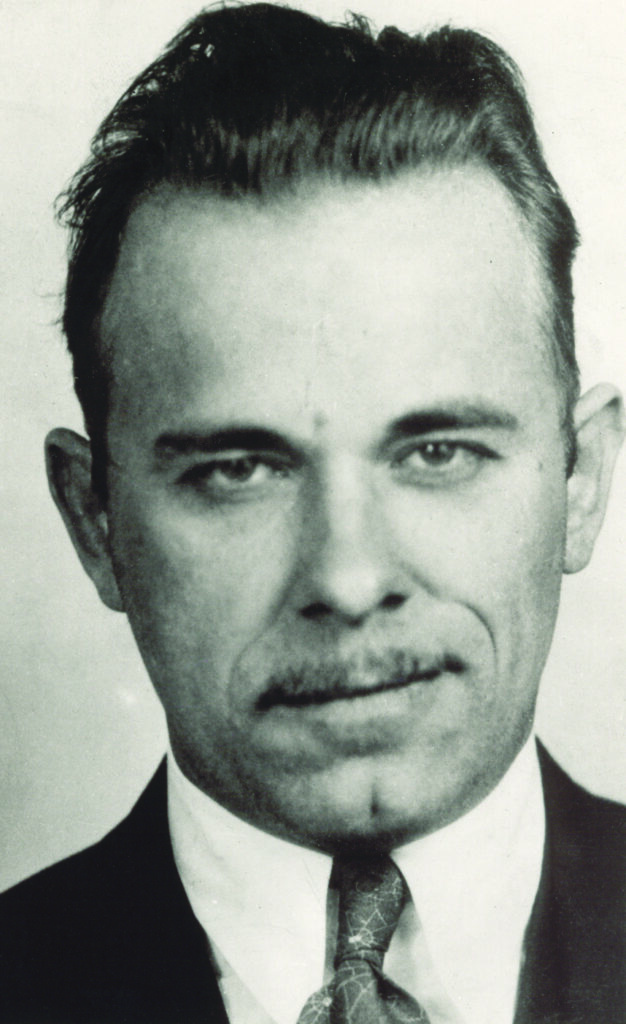
John Dillinger rose during the Great Depression, stealing money at gunpoint while the nation struggled to survive. Dillinger, named the nation’s first Public Enemy No. 1 by J. Edgar Hoover, formed a gang. That gang then killed 10 people, robbed over 25 banks, pilfered police arsenals and led three jailbreaks. Slippery and sly, Dillinger always seemed to escape prison. Over time, this gave the gangster a mythic aura. Yet it wasn’t always this way.
During Dillinger’s first stint behind bars, while he was in his 20s, he made no attempt to escape. In September 1924, at age 21, Dillinger and his accomplice, Ed Singleton, the local pool shark, were arrested for robbing a grocery store in their hometown of Mooresville, Indiana. Singleton lied, plead not guilty and was sentenced to two years in prison. But Dillinger, on the advice of his father, told the truth. All told, the truth landed him behind bars for eight and a half years. When he was paroled from Indiana State Prison on May 10, 1933, Dillinger, then 29, had spent roughly one-third of his life locked up for being honest. The truth, it seemed, kept him shackled. Bitter and disillusioned, Dillinger began his historic crime spree almost as soon as he was released, robbing a bank in Bluffton, Ohio.
Dillinger’s Dayton Days
While serving time in Indiana, Dillinger befriended a fellow inmate, Jim Jenkins, from southwest Ohio. Jenkins’s sister, Mary Jenkins Longnaker, a 22-year-old brunette, lived in Dayton. Mary, a love interest, eventually lured Dillinger to Dayton. (At the time, Mary was unhappily married to Howard Longnaker of Pleasant Hill, Ohio, so Dillinger paid for her divorce.) During that summer of 1933, Dillinger visited Mary in Dayton at least seven times. In June, he robbed a bank in New Carlisle and, in between visits, he took Mary to the 1933 Chicago World’s Fair.
Lucille Stricker, the landlady at the 324 W. First St. boarding house where Mary lived, allowed Dayton Police to intercept letters the young lady was receiving from Dillinger. In one of his letters, Dillinger detailed his imminent return, prompting Dayton Police Detective Russell Pfauhl and Sergeant Charlie Gross to stake out the boarding house. On Sept. 21, 1933, after weeks of fruitless surveillance, Pfauhl and Gross headed home. But in a bizarre twist of events, the gangster visited Mary the exact night they decamped.
Stricker, the landlady, saw Dillinger’s car arrive at the boarding house and quickly alerted the cops. Soon, the Dayton Police surrounded the boarding house, and around 1 a.m. Stricker knocked on Mary’s door. When she answered, Dillinger stood there holding photos from the couple’s Chicago World’s Fair trip. Dillinger reached for his Colt .38 Super handgun, but quickly realized it was too late. The cops confiscated the weapon.
On Sept. 22, 1933, Dillinger was arrested in Dayton. He was held at Ford Street Station, then moved to the Montgomery County Jail, where he was identified as Dayton prisoner No. 10587. Six days later, Dillinger was escorted out of Dayton and over to Lima for the Bluffton bank robbery. Two weeks later, on Oct. 12, 1933, he escaped.
The Trap
On June 22, 1934, after Dillinger and his gang had committed numerous jailbreaks, robberies, thefts of police arsenals and murders, he was declared the nation’s first Public Enemy No. 1 by FBI Director J. Edgar Hoover. (Dillinger had stolen a Crown Point, Indiana, sheriff’s car and driven it across state lines, a federal offense, which prompted the FBI to get involved.)
That summer of 1934, Anna Sage, a Chicago brothel madam, set a trap for Dillinger alongside the FBI and the Indiana State Police. On July 22, 1934, after watching Clark Gable in Manhattan Melodrama, Dillinger was shot dead outside Chicago’s Biograph Theatre. The time between his prison parole and death was just over a year. But in that time, John Dillinger managed to hold the nation spellbound. And, in doing so, he put Dayton on the map. Today, Dillinger’s Colt .38 Super handgun, the weapon that was confiscated by the Dayton Police, is safeguarded at Carillon Historical Park.
