

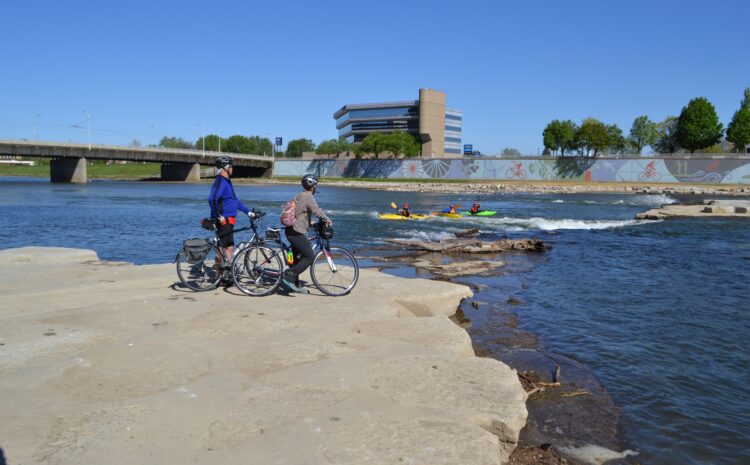
There’s no better way to fall in love with the Dayton region—and with cycling—than by exploring the area on a bike
I was 42 years old when I decided I wanted a bicycle again.
This wasn’t the fulfillment of some lifelong ambition. I hadn’t spent my youth dreaming of carbon-fiber frames or memorizing the winners of the Tour de France. In the ’80s and early ’90s, during the BMX craze, I had a Western Flyer Freedom II. Sure, it wasn’t a Mongoose or a Diamondback, but it was fluorescent green with white mag wheels.
And it was beautiful.
And then one day it was stolen.
I suspect the seeds of my cynicism were planted that day. The police couldn’t bring Green Lantern back, and a certain lack of faith in authority was instilled in me. I am today something of a misanthrope. It seems reasonable to conclude that this disposition can be traced back to a boy losing his bike.
So, at 42, I was simply ready for a new one.
I purchased a Retrospec Beaumont online, purely for aesthetic reasons. It was a rather handsome olive-drab seven-speed city bike, with fenders no less. Nary a consideration was given to performance, but it would certainly look nice leaning against the brick wall of a coffee shop.
I would soon learn that it was considerably less charming while climbing some of the hills around Oakwood with a 42-year-old man aboard who hadn’t yet developed the legs to climb them. I also learned that bicycles, like shoes, come in sizes.
At 5-foot-7, I had never been particularly self-conscious about my height. I had, of course, Googled celebrities of similar stature and determined I was in fairly good company. Bicycle geometry, however, revealed the more troubling truth that I was proportionally ill-designed, with a longer torso and shorter legs.
But something happened while I was huffing and puffing around town. I had developed a case of wanderlust.
I wanted to know where else I could go.
I discovered that by cutting through the University of Dayton campus, crossing Brown Street and slipping through the Marriott parking lot, my house was a mere 15-minute ride to the Great Miami. Somehow, I had lived here without ever considering this useful piece of geography.
Once I reached the river, the possibilities suddenly widened. I could turn north toward Riverscape or south toward Miamisburg. And from there, one trail seemed to suggest another.
Dayton looks very different from a bike.
This shouldn’t have surprised me, but it did. I had lived here most of my life. With my eyes closed, I knew how to get from Oakwood to downtown, from Dayton to Xenia, from Xenia to Yellow Springs.
Or, point of fact, I knew where the roads went.
But my bike handed me another map.
There was only one problem: I wasn’t yet equipped to explore very much of it.
The Beaumont and I pushed our range as far as Eastwood MetroPark and various points along the river. Seven speeds were seven speeds, and enthusiasm was not yet a substitute for endurance.
I had developed a yen to see what was beyond the edges of my new map.
So, I sold the Beaumont and bought an e-bike.
Cheating at Life
My Heybike Ranger S changed what was possible.
What I learned about e-bikes is that there persists a peculiar misconception that the motor does all the work while the rider sits atop the thing like a Roman emperor being carried into town. In reality, I could decide how much assistance I wanted. I could still pedal hard enough to make my heart pound. I could simply do it longer and travel farther.
And farther was precisely where I wanted to go.
It was my Nautilus. Suddenly, I was Captain Nemo with a bike helmet.
A ride didn’t necessarily have to end because my legs had reached their limit. I could spend twice as long wandering, learning how one trail joined another and discovering where they emerged.
I’m not telling my fellow Daytonians anything they don’t already know when I say our Miami Valley has one of the country’s largest interconnected paved trail networks, much of it following former railroad corridors. That’s our history, and it carries a lot of weight.
When you’re riding these trails, you’re not merely experiencing the familiar landscape more slowly. You’re moving through a geography our predecessors engineered, from a time when railroads rather than highways determined how communities connected to one another.
The backs of buildings become fronts. Our tributaries become thoroughfares. Towns that seem unrelated from behind a windshield suddenly reveal themselves as neighbors. And fields I had looked at all my life became places I could enter.
One of my favorite rides begins at Xenia Station and heads east toward Jamestown. Eventually the trail emerges into the open Greene County countryside. There I was, riding through the same pastoral landscape I had seen countless times from US route 35.
Except I wasn’t looking at it anymore.
I was right in the middle of it!
Still, not everyone approved.
Trails are generally very friendly places. There’s a pageantry of melodic bike bells announcing the approach of a fellow traveler, gentle “on your lefts,” friendly smiles and acknowledging nods.
But not always for the e-biker.
Some serious cyclists would not return such affability as they passed my abominable infernal machine. Perhaps it was a new age of prejudice, wherein the battery attached to my frame had rendered me morally suspect.
One afternoon, while cruising by Wright-Patterson Air Force Base, I spotted a teenager approaching on a BMX bike. If only he knew about my fluorescent green Western Flyer. We were practically kindred spirits.
“You’re cheating!” he shouted as he passed.
Cheating at what, exactly? I thought.
Life, I suppose.
Then there were the motorcyclists.
On a ride out to Yellow Springs, I found myself on a country road when a dude on a Harley-Davidson approached from behind. As he passed, he lifted his legs and pantomimed pedaling his motorcycle.
Within minutes, another motorcyclist passed from the opposite direction.
He blew me a kiss!
C’mon, guy. Why you gotta be like that? Can’t you see we’re the same?
Creating Your Own Horsepower
Eventually, something else changed.
Nearly every kid in Oakwood seemed to get an e-bike.
They traveled in packs, popping wheelies down the street and generally carrying on like tiny electric motorcycle gangs. They rode them less like bicycles than mopeds.
Speed was the point.
And they seemed to share the conviction that every middle-aged man on an e-bike was awaiting a challenge.
“Wanna race?”
No. I did not.
But by then I’d been riding long enough that the e-bike had accomplished something I hadn’t anticipated when I bought it.
After several years, it had helped turn me into a cyclist.
My legs were stronger. My endurance had improved. I knew the trails. I knew where and how far I wanted to go.
An avid cyclist in my neighborhood once summed up the appeal better than I could.
“There’s just nothing like creating your own horsepower,” he said, like Nietzsche delivering an aphorism.
I understood exactly what he meant.
In a car, horsepower makes distance disappear. Forty miles is nothing. You enter the vehicle in one place and then your somewhere else. The space between barely registers.
Creating your own horsepower restores that distance, reminding you that the space between is exactly the point.
A hill means something. A headwind certainly means something. Arrival is negligible.
The less horsepower I had, the bigger Dayton became.
I sold the Heybike.
I knew exactly what I wanted.
Bring On the Lucy
Under the tutelage of K&G Bike Center in Kettering, I chose a Surly Preamble, an all-road and commuter bike. But I didn’t want it to look like something that had just been rolled off the floor of a cycle shop.
I wanted my bicycle.
I knew very little about drivetrains or gear sets. What I did have were strong opinions about fenders, vintage saddles, brown-wall tires and rear racks.
Fortunately, no one at K&G seemed troubled by my priorities.
The steel frame was a wonderfully unsubtle shade called Red Hot Cheddar. I began turning the bike into something that looked as though it had escaped from another era. Velo Orange aluminum fenders and a rear rack. Chrome bottle cages. A brass Crane bell.
Brian, in particular, embraced the vision. He was certain a honey-brown Brooks saddle would complement that particular shade of red better than antique brown. And he was adamant that only Panaracer would serve this build. We finished the drop bars with wrap to match the saddle.
These were people who understood me.
I named her Lucy, after Lucille Ball.
Unlike her namesake, though, Lucy is a natural redhead.
By the time we were finished, an all-road commuter had become something resembling a vintage touring bicycle. It looks like the bike a character in a Wes Anderson movie would ride while delivering an important handwritten letter on personalized stationery to a guest staying in an eccentric European hotel.
Which is specifically what I wanted.
And, admittedly, there aren’t a lot of bike shops where a person can describe such a vision and have the staff simply say, “Yeah, we got you.”
Sure, in the world of cycling, there are lighter bikes. Faster bikes. Considerably more expensive bikes.
I don’t care.
I’m my own brand of cyclist now.
Lucy excels in the only metric I really care about: She makes me want to ride.
Unlike my former 72-pound foldable e-bike, she fits easily on the back of my MINI Cooper.
Maybe I’ll head down to Oregonia, park at the trailhead next to the Little River Bar and Grill and ride out to Morrow.
Going to Morrow
Morrow is one of those small Ohio towns where time seems to have become distracted and forgotten to continue. Approaching it on Lucy along a former railroad corridor only enhances that sensation.
Appropriately enough, people were singing about taking a train to Morrow more than a century ago. Lew Sully’s old vaudeville song “I Want to Go to Morrow,” recorded by Dan W. Quinn in the early 1900s and revived decades later by the Kingston Trio, turns the trip into an elaborate confusion over going to Morrow today and returning tomorrow.
More than a century later, I arrive in Morrow on two wheels.
It turns out the best way to get to Morrow may be yesterday.
But Morrow isn’t really the point, is it? Neither is Miamisburg or Yellow Springs or Jamestown or any of the other places I find myself pedaling toward. Arrival, as I’ve said, is negligible.
The ride is the whole ridiculous thing.
It’s the moment the tree cover gives way to open farmland. It’s discovering that a trail you’ve never ridden ends in a place you’ve been a thousand times. It’s a hill that looked considerably smaller on a map. It’s ringing your bell for someone walking ahead and hearing another cyclist call out, “On your left,” somewhere behind you.
And, for me, it’s now where I go to write.
I’m a writer. I always need an excuse to go inside my head, and cycling has become the best place I’ve found to do it. Out there, sentences rearrange themselves. Characters start talking to each other. Ideas that refuse to cooperate at my desk occasionally sort themselves out somewhere between one town and the next.
That’s part of what I’ve come to love about witnessing Dayton by bike. Our history isn’t something you merely pass on the way to somewhere else.
You can actually ride through it.
And sometimes the trail carries you into Morrow.
I don’t imagine I’ll become a collector of bicycles. I’m a hopeless romantic who was looking for his one true love.
I wanted a bike that made me want to ride. In the end, the kind of riding I loved determined the bicycle I built.
Now Lucy waits for me in the garage. And when I step over that red steel frame, I know there will always be somewhere else to go.
Even if it’s yesterday.
And, for what it’s worth, everyone smiles and nods when they pass me now.
