

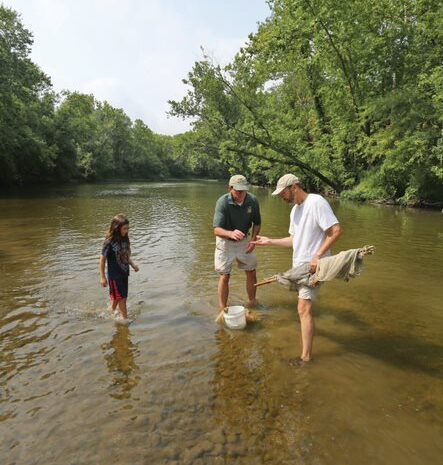
Freshwater bivalves are creating a healthier river
While once used for commerce, the 160-mile long Great Miami River is mostly used for recreation today. So when the Greater Dayton Rowing Association asked the Miami Conservancy District about using gravel from a river sand bar for a construction project rather than trucking it in, the district took it under advisement, but that was it.
The Conservancy seeks to protect the habitat of not only the aquatic life of the river, but also the freshwater mussels, filter-feeders who eliminate toxins from farm runoffs like nitrogen and phosphorous, who call the river home.
Turns out, both the Miami Conservancy District and the Greater Dayton Rowing Association were on the same page.
“While we were asking about their upcoming project to widen a section of levy for a new bike path, we asked whether it would make sense for them to use gravel from a nearby sandbar instead of trucking it in,” recalls Doug Barker, president of the Greater Dayton Rowing Association (GDRA). “The Conservancy said they would look into it, but there was no strong reaction one way or the other at that meeting. That was the last I heard about it.
“The Greater Dayton Rowing Association does not have any project of its own to remove any sand or gravel from the river. We rely on the Conservancy’s expertise in such matters and would support whatever decision they make.”
When it comes to matters of recreation versus the environment, there is no conflict among the Ohio Department of Natural Resources, the U.S. Fish & Wildlife Service, the Miami Conservancy District (MCD), local governments and recreational organizations like the GDRA, especially when it comes to the Great Miami River.
“I think recreation and heathy rivers go hand in hand,” says Mike Ekberg, manager of water resources monitoring and data analysis at the MCD. “When people get out and paddle and fish, they become quickly aware when they are in an area where a stretch of river is not doing well.
“It really comes down to allowing our rivers to do what they do naturally; to give them some room to meander, allowing them to have vegetative banks and a bit of a flood plan, and allowing the channel to do its natural thing wherever possible.”
But we also need to keep nutrients from farms out of water resources, says Ekberg, and that includes lowering levels of phosphorus and nitrogen that come from wastewater treatment plants and farms along the river.
That’s where freshwater mussels come in.
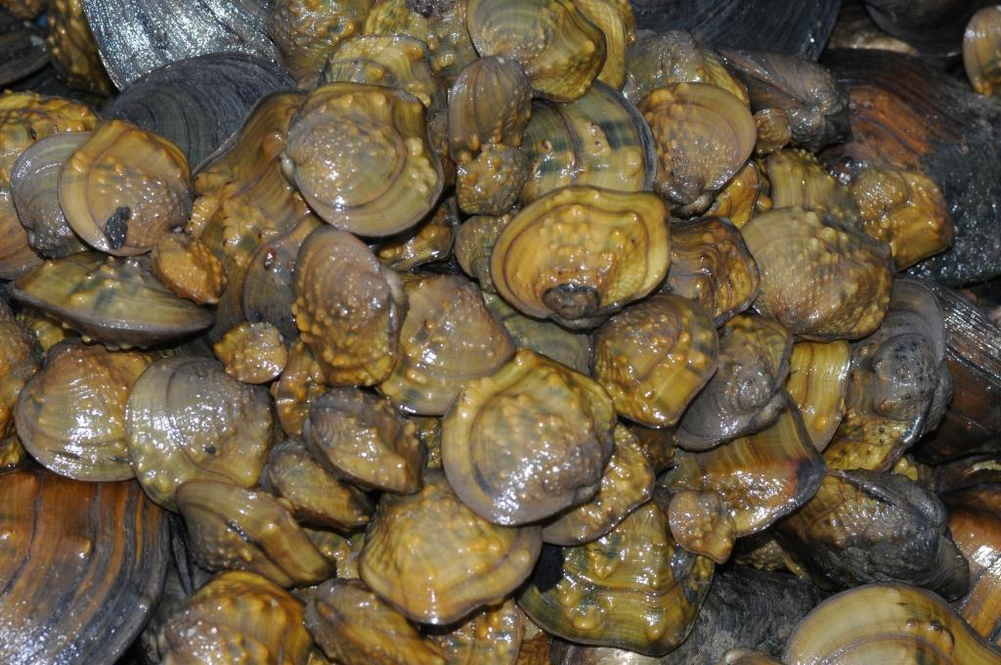
“Mussels are filter feeding organisms,” says Dr. Michael Hoggarth, a professor at Otterbein University and one of the three authors of The Freshwater Mussels of Ohio. “They suck water into their open shells and pass that water through their gills. As they do this, they filter particulates out of the water. In this way they not only collect food (which they eat) but they remove other particles, too—like the silt in water that makes our rivers brown atter a rain. If there is too much silt in the system, then that interferes with feeding.
“This mode of feeding makes them susceptible to excessive siltation and excessive pollution. They are generally lost wherever one or both of these occur. This makes them excellent water quality indicators.”
Like many aquatic organisms, freshwater mussels still face numerous environmental and man-made challenges. While freshwater mussels provide a nice habitat for fish, crayfish, aquatic insects and larval salamanders, they are also a food source for aquatic and terrestrial animals. However, you really wouldn’t want to eat one.
While freshwater mussels are edible and were once a food source for the Native American Miami, they don’t taste very good. And there is a risk of food-borne illness from what they filter out of the river. But they still are essential to our survival, especially when it comes to water quality.
While freshwater mussels are making something of a comeback in the Great Miami, certain species are starting to disappear. And both environmentalists and scientists are taking notice.
At one time, there were more than 80 species of freshwater mussels in Ohio, but today there are only about 60, according to John Navarro, Aquatic Stewardship Program administrator at the Ohio Department of Natural Resources Division of Wildlife.
“Of those, 24 species are endangered, four are threatened, eight are listed as ‘species of concern,’ 10 are extirpated and six are now extinct,” says Navarro. “Which means they are gone forever and we will never get them back.”
That’s why the Ohio Department of Natural Resources has formed a unique relationship with The Ohio State University to help freshwater mussels, says Navarro. Called the Ohio Biodiversity Conservation Partnership, OSU and the Department of Natural Resources have teamed up with the Columbus Zoo on something called the Freshwater Mussel Conservation Center.
“And we are currently working on two big projects,” says Navarro. “The first is finding out what makes a freshwater mussel tick, what their biology is. The other is raising mussels for re-introduction.”
As a part of their lifecycle, freshwater mussels use fish to relocate into new areas.
“They will modify their mantle tissue to look like a darter or some other aquatic insect, moving it around so the fish get close,” says Navarro. “Once they get in close, the mussel will shoot them with glochidia, which are larval mussels, that the fish will then carry around on their gills. It doesn’t kill the fish, who carry them around for a few weeks, when they will drop off and transform into mussels.
“What we are doing at the Mussel facility is cutting the fish host out and raising mussels in an incubator,” adds Navarro. “We put them in a medium and the glochidia transform in the incubator. Once they transform, we can restock them. This process allows us to raise thousands as opposed to a handful. It really enhances our ability to make mussels.”
Offering a helping hand to species that also helps us by protecting and filtering out impurities in the Great Miami River and the underlying aquifer that supplies Southwestern Ohio with its drinking water.
