

The Dayton International Peace Museum offers important exhibits, world-renowned speakers and a place to reflect
Founded in 2004 by Christine and and Ralph Dull, J. Frederick Arment, Steve Fryburg and Lisa Wolters, The International Peace Museum in Dayton is only one of two museums dedicated to peace in the United States. While many may think of the National Museum of the U.S. Air Force when visiting Dayton, the Dayton International Peace Museum is in many ways a counterpart to that experience.
The two primary founders were Chris (Christine) and Ralph Dull. Ralph was a farmer and Chris was a schoolteacher, and they had spent time in Russia and Ukraine as part of a cultural exchange program. Inevitably, people would ask about Dayton. The Dulls would tell them about the Wright Brothers, the Wright-Patterson Air Force Base and The National Museum of the U.S. Air Force.
The Dulls were not against the Air Force Museum but thought there should be more to talk about than that when people visited Dayton. Their goal for the museum was to provide a place for the community to learn alternatives to war, racism and violence.
“Dayton’s home to many weapons producers,” Kevin Kelly, executive director of the Peace Museum, says. “A lot of the drone technology is based in Dayton and Springfield. So, there’s a lot of reasons why it’s nice to have something else to talk about that emphasizes other ways of doing things.”
After returning from Russia, the Dulls visited the United Nations and began to imagine a peace museum in Dayton. They knew about The Peace Museum in Chicago, the only other museum dedicated to peace in the United States, but thought Dayton was a prime location for another iteration, as Dayton has a long history of peace and peace-related groups.
“A lot of them came out of pacifist and religious groups like the Church of the Brethren or the Quakers,” Kelly says. “There was already a lot of that happening around the Miami Valley well before we came along.”
Additionally, Dayton was host to the 1995 Peace Accords that ended war in Bosnia. “[It] really does make it full circle,” Lisa Wolters, one of the founders, said to the Dayton Daily News. “Really, though, it doesn’t matter where the museum is—it’s about having a place where people can make peace and feel that.”
The initial idea for The International Peace Museum was for it to be similar to Chicago, in that it would house artifacts and manuscripts related to peace movements over time. When Kelly joined the museum, he was a part of a movement to expand the scope of the museum.
“We’re finding ways that educate young people, especially through a program we’ve developed called Peace 101,” Kelly says. “When I was young, I remember taking health classes or classes about civics and values and doing the right thing. Those classes sort of got replaced by keyboarding. So, kids really don’t learn some of those things that we assume that they’re picking up in other ways and they really aren’t.”
Earlier this year, from Jan. 30 to April 4, the Peace Museum celebrated “A Season for Nonviolence,” which was started by Mahatma Gandhi’s grandson, Arun Gandhi. The two dates represent the date that Gandhi was assassinated in January and the date that Martin Luther King Jr. was assassinated in April. The museum was asked by Tushar Ghandi (Mahatma Gandhi’s great-grandson) to celebrate the season.
In January 2024, members of Gandhi’s family, MLK Jr.’s family and Coretta Scott King’s family visited the museum for a weekend of events and discussions. This 64-day season and celebration will continue to be celebrated at the museum next year and the years following.
On May 17, the Peace Museum opened a new exhibit, a photo essay from Rick Polhamus, who is a “peace builder.” He is a part of Christian Peacemaker Teams and has visited Israel, Palestine, Mexico and Puerto Rico as mediator, pacifist and activist. This exhibit will focus on his peacebuilding work in Israel and Palestine and photos that he has taken over the past 30 years of his work. He will be speaking at the museum June 15, and the exhibit will be open until July 14.
The museum is also planning a climate justice initiative. “Environmental justice is just like any other justice,” Kelly says. There will be exhibits and virtual reality experiences to help visitors understand what is happening with climate change on a “world level.”
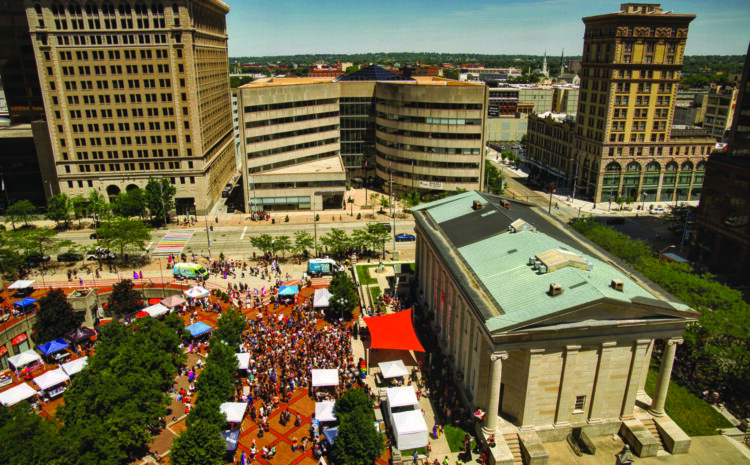
In May 2024, the Dayton International Peace Museum celebrated 20 years, but it’s only been two years since it moved to its current location on Courthouse Square in downtown Dayton. However, in those years, the museum has found many partners and supporters, from Sinclair Community College, the University of Dayton and The Dayton Foundation to country singer Willie Nelson and actor (and Dayton native) Martin Sheen.
For Kelly, the presence of this museum is important beyond what it exhibits.
“We’re working on bringing in relevant exhibits and having deeper conversations with people and developing—something I didn’t come up with, but something I’ve adopted—which is the idea of a third place,” he adds. “Home’s first, work’s second (or school), and then the third place. And those third places have really disappeared for many people.”
While many people still have a “third place,” such a church or a weekly club, Kelly wants the museum to be one of these third places for people to visit and learn about the world around them and about peace.
“The thing that people don’t get about peace is it’s not really the absence of something,” Kelly says. “Peace is actually much more difficult to attain than war is. War is easy. Especially when you have all kinds of devices that make it easy to kill people or control people. But getting things to be not like that and to be in an environment where everyone’s treated well and has what they need, what we call positive peace, that is much more difficult.
“Positive peace is where you create the environment for that to happen,” Kelly adds. “You wouldn’t expect a garden to thrive unless you put a lot of work into it and made sure the soil had what it needed and had enough water and the pH was right. That’s what peace is about: getting that environment conducive so that people will be OK.”
