


Dayton Live CEO reflects on a year without shows and what’s next for the arts organization
With the stage darkened for more than a year, Dayton Live’s 2021-2022 season not only marks the “official” first season under the new brand, it also signals an important final act for the pandemic.
Dayton Live President and CEO Ty Sutton says that he and his staff faced many hardships when public health orders canceled public gatherings and then continued to only allow indoor spaces to operate at a diminished capacity.
“To say it was difficult is an understatement,” Sutton says. “We set up a war room where we worked furiously to communicate with the public and do what we could with our shows. Lots of 20-hour days for our staff. We thought it would be for three, six or maybe eight weeks. It certainly changed our plans for how we were going to roll out the Dayton Live brand.”
Formerly the Victoria Theatre Association, the performing arts organization wanted to better position itself for touring productions and better represent all the types of performances and organizations sharing the real estate assets Dayton Live owns and manages. That switch took place in March 2020, right before the pandemic struck Ohio in earnest.
“You come off this huge high, announce a new brand and everything that’s going on,” Sutton says. “Thousands of people are so excited, and next thing you know, you’re closed down and you’re in this state where you don’t know what that means or the long-term implications.”

Maintaining all those physical assets presented a huge challenge for Dayton Live. The organization owns and operates the Benjamin & Marian Schuster Performing Arts Center, Victoria Theatre, the PNC Arts Annex and Metropolitan Arts Center (home of The Loft Theatre), plus the Arts Garage.
“We had to strip down to our core function, taking care of all that space—four times the size of the Dayton Convention Center,” Sutton says. “We felt that we couldn’t go to the community and ask to fill our $290 million gap when there was so much help needed everywhere. We had to downsize staff by almost 90%. We took it day by day and tried to raise money, line up credit, ready to borrow and work with the shows. We needed to make sure we could come out of the pandemic ready to serve our mission. As the pandemic hopefully wound down, we’d have to live with the consequences of those decisions.”
One such successful fundraising campaign took place last June. The Day of Giving featured virtual performances by local ensembles the Dayton Contemporary Dance Company, Dayton Dance Initiative, Dayton Gay Men’s Chorus, Dayton Performing Arts Alliance (Dayton Ballet, Dayton Opera and Dayton Philharmonic) and The Human Race Theatre Company. More than $68,000 from 300-plus donors was raised during the 10-hour fund drive. For Sutton, it was another example of the generosity of his new hometown and underscored the importance of the arts to the community.
“I think working together, everyone really pulled for each other and worked with the city, county, state to get us dollars we needed to survive,” Sutton says. “The arts community in Dayton is unique because we have arts groups that outsize the population of our community.”
But the vast majority of funds required to save the stages included local, state and federal financial relief packages. Sutton reminds patrons that even with relaxed restrictions and booked shows, Dayton Live is not out of the woods yet. “Our recovery will take three to five years, and we’ll continue to need some kind of support at the state and federal level.”
Advocacy for the arts will remain a high priority to keep the lights on not only for Dayton Live venues, but for the restaurants, hotels and other businesses that thrive when the arts are alive and well.
“Arts aren’t just a nice thing, there’s also an economic impact from the arts,” Sutton says. “If we’re not offering performances, you won’t see those 500,000 people coming to Dayton and going to dinner, or staying in hotels, or buying gas, or doing all these things that contribute to the economy,” which rings in around $30 million a year. “I’m grateful that people in our community and around Ohio who reached out to their representatives and said, ‘We need to save these companies and save these organizations.’”
Sutton says with that funding in place, Dayton Live could begin assembling its season. Among the intimate talks, eclectic artists and popular Broadway programming hitting the stage the rest of the year and into the next, perhaps one of the most anticipated shows expected to draw huge crowds back to the Schuster Center is the performance of historical hip-hop sensation Hamilton. But Sutton reminds audiences to explore the lineup thoroughly to find other real gems.
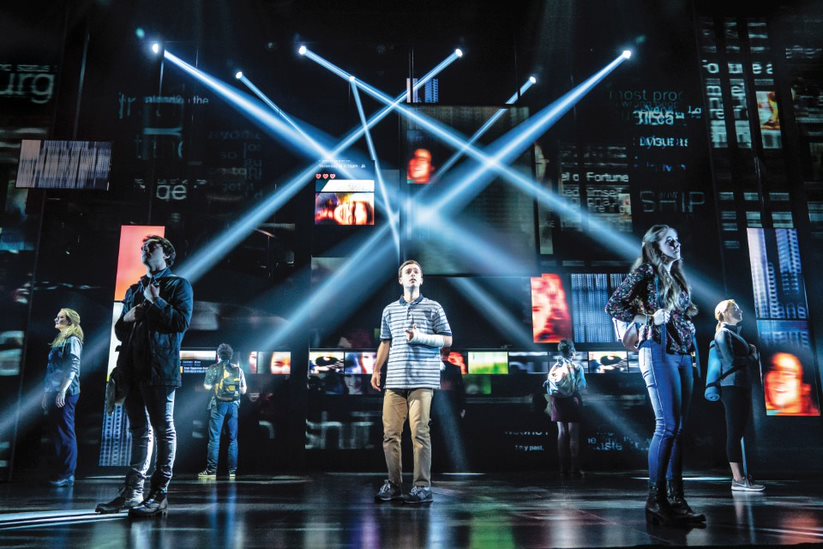
“One of my favorite shows is Come from Away,” he says. This musical is based on the true story of when 38 planes had to make an unexpected landing in the town of Gander, Canada, following the Sept. 11 attacks. The show revolves around how the town rallied to help the nearly 7,000 stranded travelers and offers a glimpse of humanity at its best and most empathetic. “It’s the ‘perfect show’ for Broadway newbies—based on a true story just about everyone can relate to.”
Other sleeper highlights from this season include a visit from celebrity cooking personality Alton Brown, performances by Dayton favorites Straight No Chaser and a Japanese Taiko drumming performance called Drum Tao.
Educational programs will be back on the market as well. One positive element that Sutton says may stick around post-pandemic are virtual classroom offerings.
“With programs from Step Afrika, Black Violin and (local STEM educator) Mister C, we’ve been able to connect with over 100,000 students through the pandemic, and offered at no cost to schools,” Sutton says.
Ticket sales are likely to be in a bit of flux. As of this publication, Ohio will have repealed its public health orders, which limited in-theater capacity. Of course, nothing with this epidemic has been certain, and Sutton and the Dayton Live crew certainly aren’t taking anything for granted. Safety protocols and sanitization practices will still be followed to ensure the health and well-being for patrons, staff and the touring performers visiting the Gem City.
Sutton says learning to adapt and identifying opportunities to make positive change was one of his key takeaways from a year of dark stages. “The biggest lesson I’ve learned is when faced with a crisis, you have to embrace some uncertainty, and you have to learn to live with uncertainty,” Sutton reflects.
But one thing remains consistent—Sutton believes in the passion this community has for its arts scene. “I don’t know there’s anywhere else in the country that has this collection of amenities. I’ve lived and worked in bigger cities, and I’d put up Dayton against any of those places anytime,” Sutton says.
