

America’s iconic orange cracker—a Dayton original—turns 100
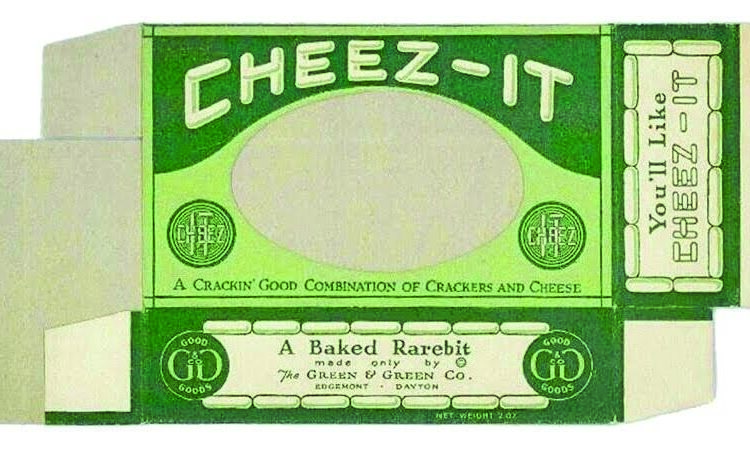
Dayton’s historic Edgemont neighborhood is cocooned inside a crook in the Great Miami River, a winding waterway that snakes through the heart of southwest Ohio. Two miles southwest of downtown, the Edgemont community, with its air of industry, hearkens to a time when Dayton was hailed The City of a Thousand Factories. In the early 20th century, inside a factory on the corner of Concord and Cincinnati streets, Green & Green cracker company cooked up its Edgemont product line, a collection of “good goods” named for the surrounding Edgemont neighborhood. But of the company’s four Edgemont products, only one—a flaky one-by-one-inch cheese cracker—would revolutionize snack time. On May 23, 1921, Green & Green decided to trademark the tasty treat’s unique name. Cheez-It was born.
This year, America’s iconic orange cracker turns 100. But the Cheez-It story stretches far beyond a century.
The Dayton Cracker
In 1841, Dr. William W. Wolf moved to Dayton to practice homeopathy, a branch of sectarian medicine that believed in the healing power of food. Hailed Dayton’s “Cracker King,” Wolf concocted the Wolf Cracker, a curious hard-butter snack made for medicinal purposes—a health food that, so the doctor believed, aided digestion. But Wolf’s patients weren’t the only ones after his crackers. What started as a medical remedy soon became a sought-after treat.
In the 1870s, while living on the barren plains of North Dakota, Dayton natives J.W. and Weston Green often longed for a taste of home. “In those days food supplies were both expensive and scarce in that region,” wrote the Dayton Journal Herald in its October 31, 1907, edition, “and the father and son regularly sent back to their old home city, Dayton[,] for those necessities that could not be obtained there. ‘Invariably,’ Mr. Green says, ‘we would include in that order a good supply of … the ‘Wolfe Cracker’ [sic].”
J.W. Green never forgot the savory, buttery “nut-like” flavor of Wolf Crackers. In 1897, when William Wolf died, he purchased the Wolf Bakery Company, then enlisted his son, Weston Green, to join him in business. The Greens renamed the enterprise Green & Green Company, and while Wolf’s recipe remained the same, they rebranded the doctor’s famous treat as the “Dayton Cracker.”
Fighting Bread
By the turn of the 20th century, Dayton held more patents, per capita, than any U.S. city. Surrounded by this innovative environment, Green & Green flourished. But soon, the company’s crackers became more than a local concern. During World War I, Green & Green fired up its ovens for the war effort.
“All our facilities but one little oven that can’t be used for Hard Bread will be speeded up to keep two car loads a day going by express,” read a Green & Green ad in the Dayton Daily News’s July 14, 1918, edition … “that OUR BOYS at the front may have their Fighting Bread.”
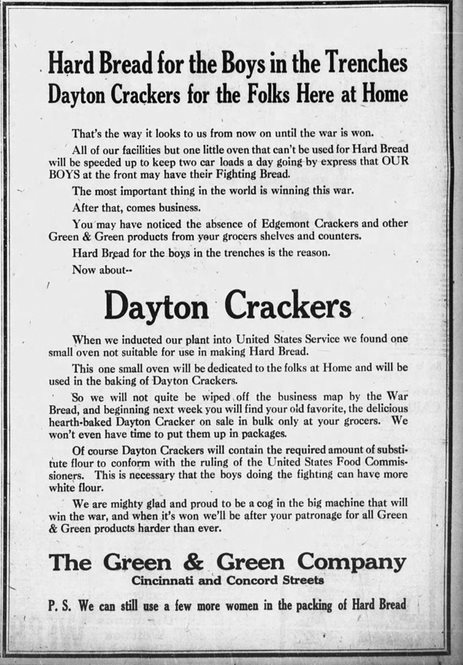
Though far less tasty than the Dayton Cracker, Dayton’s Fighting Bread sustained countless soldiers during the Great War. Typically made from salt, flour, and water, Hard Bread—also known as hardtack, teeth dullers or jawbreakers—was often soaked in water before being served. If stored improperly, weevils and maggots made Hard Bread their home, prompting soldiers to dub the wartime ration “worm castles.”
“We are mighty glad and proud to be a cog in the big machine that will win the war,” read Green & Green’s July 14, 1918, Dayton Daily News ad. However, Doughboys weren’t the only ones helping win the war. “P.S. We could still use a few more women in the packing of Hard Bread.”
The Baked Rarebit
After World War I, Green & Green Company sidelined Hard Bread in favor of more flavorful fare. By Armistice Day, the Dayton Cracker (still made with Wolf’s original recipe) had been baked in Dayton for nearly 80 years. But while the hard-butter cracker was a local treasure, customers yearned for a delicate, flakier, layered treat. Soon, Green & Green launched its Edgemont line, and, in 1921, unveiled the Cheez-It: the “baked rarebit.”
But in 1921, Americans needed more than a novel snack. Following the Great War, the global economy dipped, and American wallets were increasingly thin. Around this time, one pound of Green & Green crackers sold for 10 cents, roughly $2.65 in 2021 dollars. “When Uncle Sam picked men for his army overseas,” read a June 1920 Green & Green ad, “he also picked foods that would keep those picked men robust and healthy—fit for the strenuous duties ahead of them. Just as the crackers for our soldiers kept sweet and fresh in tins, so Edgemont Crackers … keep crisp and creamy in the Family Tin. Ask mother to keep a tin in her pantry.”
Cheez-Its kept Americans fed during the post-war recession, through the Roaring ‘20s, and at the onset of the Great Depression. But by 1932, Green & Green packed up its last Family Tin and sold its cracker business to Kansas City’s Loose-Wiles Biscuit Company.
The Cheez-It
In 1947, the Loose-Wiles Biscuit Company became the Sunshine Biscuit Company; in 1996, Keebler acquired Sunshine; and in 2001, Kellogg acquired Keebler. But the Cheez-It name has been connected to the baked cracker since its 1921 creation. Originally, the Cheez-It packaging was green and white, though the cracker’s shape and look have mostly remained the same.
Cheez-Its may still look the same, but the cracker’s production has soared. Cheez-It, once baked on the corner of Concord and Cincinnati Streets in Dayton’s Edgemont neighborhood, then shipped to local grocers, has landed in mouths across the globe. The tasty treat has been rolled out and cooked up for over a century now. Like the Cheez-It story itself, we need only bite in to uncover countless compelling layers.
