

How a piece of the original Wright Flyer landed on Mars
Mars stands four planets from the sun, a cold, craggy, two-mooned world named for the Roman God of war, its rusty red surface evoking a blood-stained hue. The planet, with its thin atmosphere, colossal canyons and towering Olympus Mons volcano—three times the height of Mount Everest—has long mystified humanity. But on April 19, 2021, a small aircraft made huge progress in unfurling the mysteries of Mars.
Ingenuity, the 4-pound solar-powered helicopter built by NASA’s Jet Propulsion Laboratory (JPL) not only accomplished the first powered, controlled flight on Mars but also the first powered, controlled flight on any other planet. JPL is hailing the initial 39-second flight as a “Wright brothers moment.”
After intense preparation, the 19-inch-tall Ingenuity chopper was fastened to the belly of Perseverance, the Mars rover gathering geological data, searching for signs of ancient life. On February 18, 2021, both vehicles landed safely atop the Red Planet. Now, Ingenuity’s success has helped determine that NASA can, indeed, deploy future Mars helicopters, helicopters that might aerially survey the Red Planet’s rocky terrain. Perhaps, one day, these helicopters might even help astronauts explore Mars.
But NASA is not only concerned with the first flight on another planet. To honor the first flight on Earth, the flight team fastened a small 1903 Wright Flyer fabric swatch to the underside of Ingenuity’s solar panel. On April 19, 2021, three days after Wilbur Wright’s 154th birthday, a piece of the world’s first airplane lifted off from Mars.
But where did the fabric from the original Wright Flyer come from? And how did it make it to Mars? That’s a story all its own.
Collecting the Pieces
Dayton stands in the heart of Middle America, a midsize city with a giant history. The Wright brothers, two West Dayton bicycle makers, are certainly the city’s most famous sons, but Dayton gave the world more than the airplane—the community also provided advancements in trains, canals and automobiles.
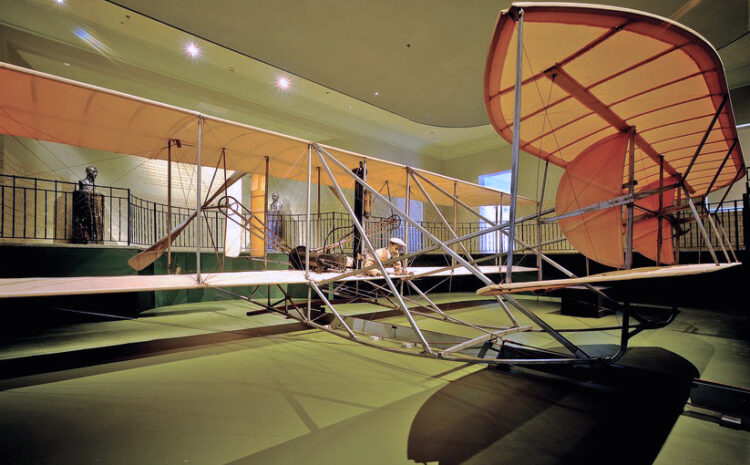
In the 1940s, in an effort to preserve Dayton’s transportation history, NCR Chairman of the Board Edward Deeds began work on a transportation-themed museum—Carillon Park—and asked his friend Orville Wright, then in his 70s, to help him make the Wright brothers’ story a centerpiece of the new attraction. Deeds’ idea was to build a replica of the 1903 Wright Flyer, the world’s first airplane.
While Orville was supportive of Deeds’ Wright Flyer replica concept, several days later the pilot returned with a landmark idea—one that would preserve the brothers’ most significant airplane and, as an unforeseen byproduct, enliven future space explorations. Orville considered the 1905 Wright Flyer III, the first practical airplane—a plane that could take off and land, turn figure eights and fly so long (some 40 minutes) that it ran out of gas—to be the brothers’ most important contribution to aeronautics. This would be the airplane he would gift to Carillon Park. But first he had to find the parts.
While the Wright Flyer III airframe was safely in storage, many of the plane’s components were strewn across the map. In 1908, in preparation for their first famed public flights at Hunaudières Racecourse near Le Mans, France, the brothers had returned to Kitty Hawk with the Wright Flyer III, modified the aircraft, then ran a series of test flights.
After the test flights, the brothers built a refined version of their 1905 Flyer, the Wright Model A, then stored the 1905 Wright Flyer III in their Kitty Hawk hangar—a weathered wooden structure that rose like a southwest Ohio barn from the sands of North Carolina. After the brothers became world famous, souvenir hunters began busting into the hangar to steal parts of the Wright Flyer III. In order to get the pieces back—in order to rebuild the plane for Carillon Park—Orville had to offer the souvenir hunters some sort of incentive. He had a thought.
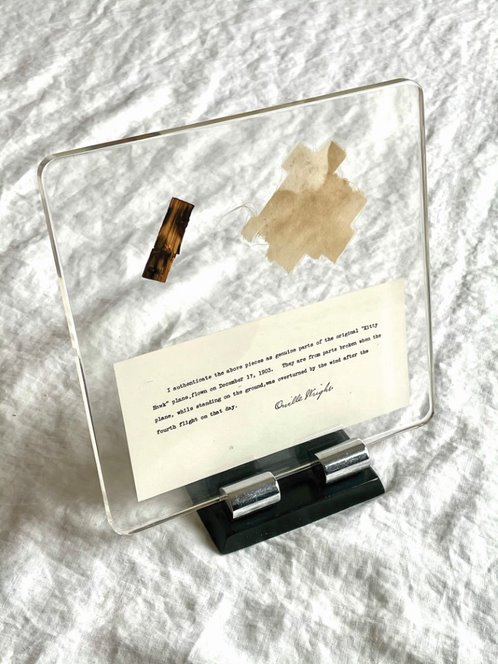
While restoring the 1903 Wright Flyer, its Pride of the West muslin fabric was removed, as were small wooden components. Orville still possessed both, so he sealed a piece of fabric and wood from the 1903 Wright Flyer, along with a letter of authentication, inside a lucite plaque and offered them in exchange for the 1905 Wright Flyer III components. It worked.
After retrieving the 1905 Flyer components, Orville helped restore the plane for Carillon Park, then helped design Wright Hall, the building where the plane is displayed. But after the project was completed, there were a number of leftover, ungifted pieces of 1903 Wright Flyer ephemera. Perhaps, one day, they’d find a use.
Into Space
On January 30, 1948, Orville died of a heart attack. (The first pilot’s last project was to restore the 1905 Wright Flyer III for Carillon Park). Some 20 years later, Neil Armstrong, a native of Wapakoneta, Ohio, a small city 60 miles north of Dayton, finally found a use for Orville’s leftover 1903 Flyer memorabilia; in July 1969, Armstrong carried a small piece of wood and swatch of fabric from the Wright Flyer aboard Apollo 11 as he landed on the moon.
Thirty years later, John Glenn, a native of New Concord, Ohio, some 140 miles east of Dayton, followed Armstrong’s lead when he took a 1903 Wright Flyer fabric swatch aboard Discovery. In October 1998, Glenn, age 77, became the oldest human to travel into space.
The tradition, of course, is continuing today with Ingenuity, the Mars Helicopter. Ingenuity’s flight date had to be bumped twice before NASA saw success. Still, all the while, the organization was channeling the spirit of the Wright brothers who, after years of painstaking care and countless setbacks, finally flew some 118 years ago.
