

AI and other advanced technology detecting cancer earlier than ever
In the Miami Valley, the health care system is experiencing a common trend: AI cancer detection. While AI (artificial intelligence) seems brand new, many local practices have been utilizing it for several years.
At Kettering Breast Evaluation Centers, AI has been used since 2019. Sally Grady, the director of Kettering Breast Evaluation Centers, stresses that both types of AI they use—ProFound AI and Volpara—have made a significant impact on patient care and management and on the radiologist.
“[AI] helps clinicians improve their cancer detection rate,” she says.
Dr. Satheesh Kathula of Premier Health’s Blood and Cancer Center may know this better than anyone. He has been practicing oncology for 22 years in Dayton and is certified in Artificial Intelligence in Healthcare from Stanford University.
“A lot of tests and treatments in oncology and health care in general are interpreter or reader dependent and human errors are not uncommon,” he says. “AI is extremely good at pattern recognition using the available data and an as adjunctive tool it holds a great potential in improving cancer care ikan several ways.”
Early detection of cancer, workflow optimization, drug discovery and development, cancer clinical trial accuracy, and radiation therapy planning are all improved using AI.
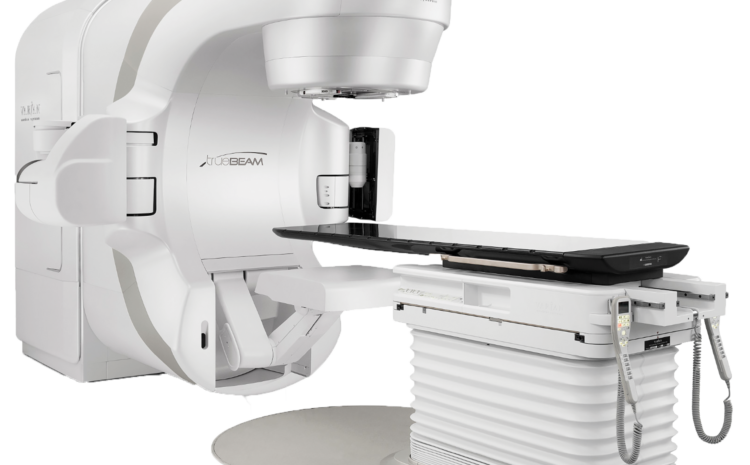
At Dayton Physicians Network, AI has not been used yet, but other advanced technologies have improved its patient care and cancer detection and treatment. It uses Varian TrueBeam technology, which allows patients to be treated with more precision, therefore controlling the tumor with less side effects, according to Dr. Ryan Steinmetz at Dayton Physicians Network.
Steinmetz is a radiation oncologist and works closely with these technologies. “I believe the next generation of advanced technologies will incorporate personalized cancer care,” he says.
At Kettering Breast Evaluation Centers, ProFound AI provides the radiologist with key information. One of those pieces of information is called a Case score and the other is called a Certainty of Finding lesion score.
Both scores are beneficial to the radiologist. “It helps their efficiency, and it really helps us with patient care, too,” Grady says.
This is important, as in 2023, Kettering Breast Evaluation Centers performed 92,000 mammograms. With this number of tests, ProFound AI is increasing accuracy without decreasing patient care as radiologists can prioritize more serious cases.
“It’s a gamechanger in a lot of different ways,” Grady says.
At Premier, AI has helped with drug prescription. “When I started my oncology practice 22 years ago, there were handful of drugs and now we have hundreds and so many are coming into the market every day,” Kathula says. “Not everyone responds to these drugs similarly. AI can potentially predict who will respond and who will not, to a particular drug.”
Volpara Health’s breast cancer AI detection software, which is also used at Kettering Breast Evaluation Centers, evaluates a different type of risk.
After inputting patient answers to a series of questions, Volpara generates a free cancer risk assessment based on individual risk factors and family history. Volpara also measures breast density, which can affect the risk of breast cancer, and can only be measured by mammogram or a breast MRI.
Ovarian cancer, which is particularly hard to diagnose due to its difficulty of spotting on an X-ray and its lack of symptoms, is uniquely primed for AI technology’s help. Grady is excited to see how AI can help ovarian cancer detection, prevention and treatment.
Steinmetz and his team at Dayton Physicians have been able to use their technology to improve patient care. “These technologies have allowed radiation oncologists at Dayton Physicians to treat tumors with ‘laser-like’ precision thereby sparing normal tissues,” he says. “This results in improved cancer eradication and lesser side effects. Our technology allows the patient to be treated in a more comfortable setting and with a shorter duration of treatment time.”
Steinmetz emphasizes that they are always innovating. “At Dayton Physicians, we exhaustively search for the latest technology based on clinical trials to provide the best possible care for our patients,” he says.
Grady, who has been director of the Kettering Breast Evaluation Centers since July 2018, knows the value of these technologies to patients. “Every woman that comes in for a mammogram is scared,” Grady says. “They all come in thinking we’re going to find something. If we can use all of these tools to produce a higher quality mammogram and sustain that quality, we’re not going to let up. It’s easy to say you’re world class, that you offer world class quality, but we actually have the data to prove it.”
“AI has the potential to improve patient care and management by improving diagnostic accuracy, personalizing treatments and enhancing workflow efficiency,” Kathula says.
Though AI is a helpful tool, radiologists still use their own judgement and vast education if there is a reading that they do not agree with. “It’s a companion tool to all the years of experience and education that they have,” Grady says.
Kathula also says that AI has been welcomed at Premier, but there was some apprehension. “Health care is one of the last ones to adopt technology, understandably, because of the lack of trust with machines and potential for errors which can be disabling or life threatening,” he says. “We had similar concerns when we started using electronic medical records and other technologies several years ago and they have become not only a part of the routine practice, but a necessity now.”
Grady stresses that while AI is helpful to the medical professional, it’s more important that it benefits the patient. “Our goal is to detect cancer when it’s at its smallest form and the easiest to treat so the patient can have the best outcome,” Grady says. “That’s why we use AI. It’s really all to benefit the patient. There is a patient at the end of every single thing we do. If we can provide a better outcome for them, then that’s exactly what we’re here for.”
