

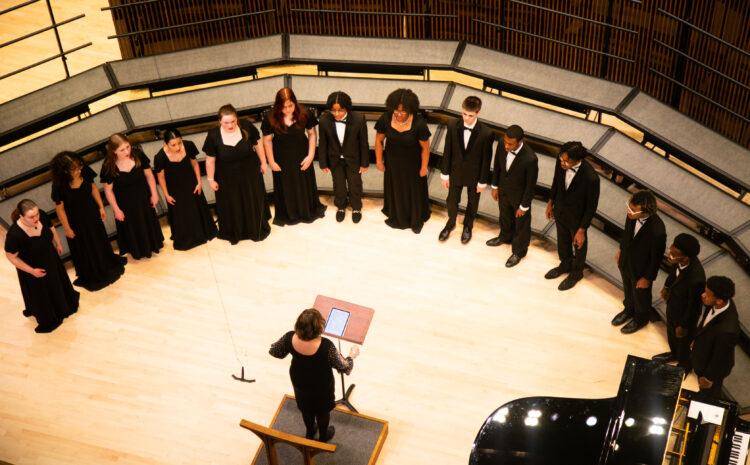
Exploring the role of visual and performing arts education in post-secondary learning
Visual and performing arts have been an integral part of the college experience for decades. Not only are students majoring in the arts in pursuit of a career in their chosen field, those not studying for a future arts role are encouraged to participate. But are the arts still relevant in today’s world? Are these students amply prepared to enter the workforce? What is the value of arts classes for nonmajors? Local arts educators weigh in on these issues, and what it could mean for the future of arts education.
Why Arts Education
Colleges and universities have been offering visual and/or performing arts classes for generations.
Locally, Wright State University (WSU) Interim Chair of Fine and Performing Arts, Steven Aldredge says the arts programs are as old as the institution itself.
He estimates there are 550 total arts majors enrolled at the school. Nonmajors also participate in a big way, with as many as 1,600 students.
“Any given time we’re reaching around 15 percent of our entire student body, if not more,” he says.
University of Dayton (UD) Department of Music Chair Toby Rush says roughly 20 percent of students are enrolled in a course in performing and visual arts.
“Our arts programs receive real, meaningful support from our administration not only through financial support but through our president, provost and deans regularly attending our productions,” Rush says.
Although aptitude for a particular medium certainly can influence a student’s decision to participate in a visual or performing arts class, they are getting more than just extra practice out of their experience.
Tracy Longley-Cook, WSU associate professor of art, says two of the most important skills arts classes teach are collaborative work and communication.
“We live in a visual time. One thing that’s important is teaching visual literacy and applying critical thinking to what you see,” she says. “That’s important for any future employee in the workplace or just to be a better-informed citizen.”
The benefits of arts programming extend to career-focused institutions, like Sinclair Community College (SCC).
Kelly Joslin, art department chair and professor at SCC, says the workforce-prep college’s arts courses enhance critical thinking, problem-solving and creativity—skills that are valuable in today’s job marketplace.
“Engaging with the arts fosters cultural awareness, emotional intelligence and adaptability, making students well-rounded professionals,” she says.

Different Career Options
What waits for visual and performing arts majors after graduation? Pursuing their craft professionally is an option, but it’s not the only one.
Dean of the College of Liberal Arts at WSU, Gary Schmidt, says skills students learn in their respective fields of study can be applied to many careers.
“Acting majors tend to be articulate and self-confident and convey messages well. Those students can find roles in public speaking or training,” he says. “CEOs, human resources, team leaders in public or private sectors—you can find people everywhere with roots in the arts.”
Nichol Simmons is the director of WSU’s Tom Hanks Center for Motion Pictures. Graduates from her program can be found in front of and behind the camera at television news stations, and in myriad roles in the role of content creation for film, streaming services, social media—even business-to-business functions.
“How many of us have sat through training videos?” Simmons says. “That’s acting, that’s film, that’s music, that’s graphic design…someone produces and sells that human resources content.”
These same skills can enhance job qualifications for non-majors, as well. Dayton native Trinity Rice is studying music performance and theater studies at UD, and she says it’s important for her peers outside the visual and performing arts majors to take classes.
“The arts provide a healthy outlet for stress and emotional expression. Especially if you’re in a STEM-heavy major like engineering, it can allow you to use a different part of your brain and learn to approach situations from a different perspective,” she says. “I think that in today’s world, critical thinking is a skill everyone should sharpen in order to consume media responsibly. It also encourages introspection and a more profound observation of the world around us.”

What if There Was No Art?
Across the Miami Valley and throughout the country, colleges and universities have grappled with cumbersome and ever-changing funding structures, leaving the arts vulnerable to budget cuts. It’s a future Rush would rather not contemplate.
“So much of the character of our campus life is shaped by the arts, from the beautiful painting and sculptures around our campus, to the many recitals, concerts and theatrical productions occurring on a regular basis, to the culture of live music in our student neighborhoods and the rousing sounds of the Pride of Dayton Marching Band and the Flyer Pep Band at our sporting events,” he says.
WSU’s Associate Chair of Fine and Performing Arts, Marya Cordes, agrees with Rush. “The arts are the difference between being human and being a robot,” she says. “The arts provide the color on the walls, the music in the air, the beauty from within. If we don’t have these things, I don’t see a world in which we coexist well.”
One recommendation that every faculty member shared was for the public to feel more invested in the value of visual and performing arts by experiencing it first-hand. Almost every college and university in the Miami Valley has publicly accessible galleries, concerts, plays, musicals, film festivals and other means of showcasing students and faculty talents. Open enrollment classes and community enrichment programs provide the opportunity for hands-on experience.
Longley-Cook encourages everyone to explore these spaces and events. “Don’t be shy about coming! Whether to see a show or walk through a gallery, we are very welcoming,” she says. “We want to share this joy in our lives. We are in these fields because we fell in love and we want visitors to experience that, too. We want to see that enrichment spread across the community.”
