

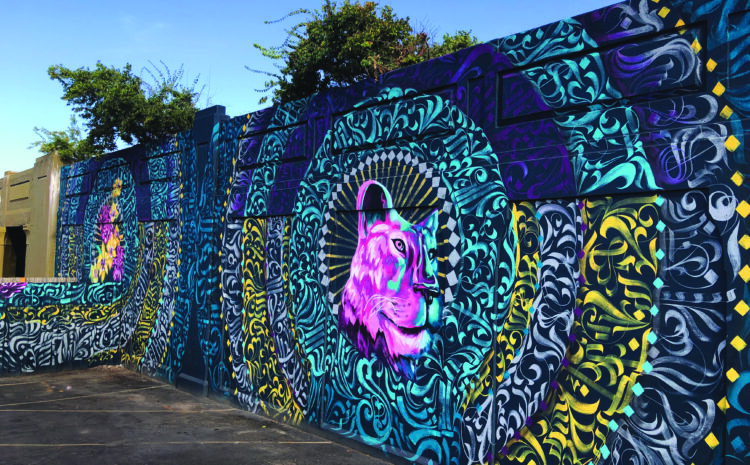
Muralists in Dayton make streetscapes lively and vibrant
From the caves of Lascaux in France to the barn quilts adorning farms across Ohio, artists have shared creations in the public environment. Murals have been making their mark on cities, villages and other public spaces for thousands of years. Ancient Greeks painted frescoes on wet plaster around 1500 B.C. and can still be observed today. That desire to share art in public spaces has spread to Dayton and the Miami Valley, with new murals appearing in the region each year.
Civic Pride
Murals brighten sidewalks in communities throughout the Miami Valley. “Great design and art can transform spaces and affect our happiness and well-being,” says Eva Buttacavoli, executive director at The Contemporary Dayton (The Co). “Attention to the details of our environment leads to love of place, which brings us to take responsibility for the spaces where we live and work. And by extension, to our communities, our cities, our nations and our world.”
Many municipalities are taking note. The city of Centerville created a new mural program in 2021. The Centerpieces Mural Program is funded by the Centerville Community Improvement Corporation, which is a nonprofit organization that supports economic development projects by issuing business loans and holding and redeveloping commercial properties. The mural program is a new foray for the organization, but it’s yielded positive results.
“Public art can almost immediately inject vibrancy into a neighborhood,” says Kate Bostdorff, Centerville communication director. “The goal of the Centerpieces Mural Program is to showcase the creativity and vision of artists through high-quality artwork and present a diversity of artistic styles and perspectives throughout the city.”
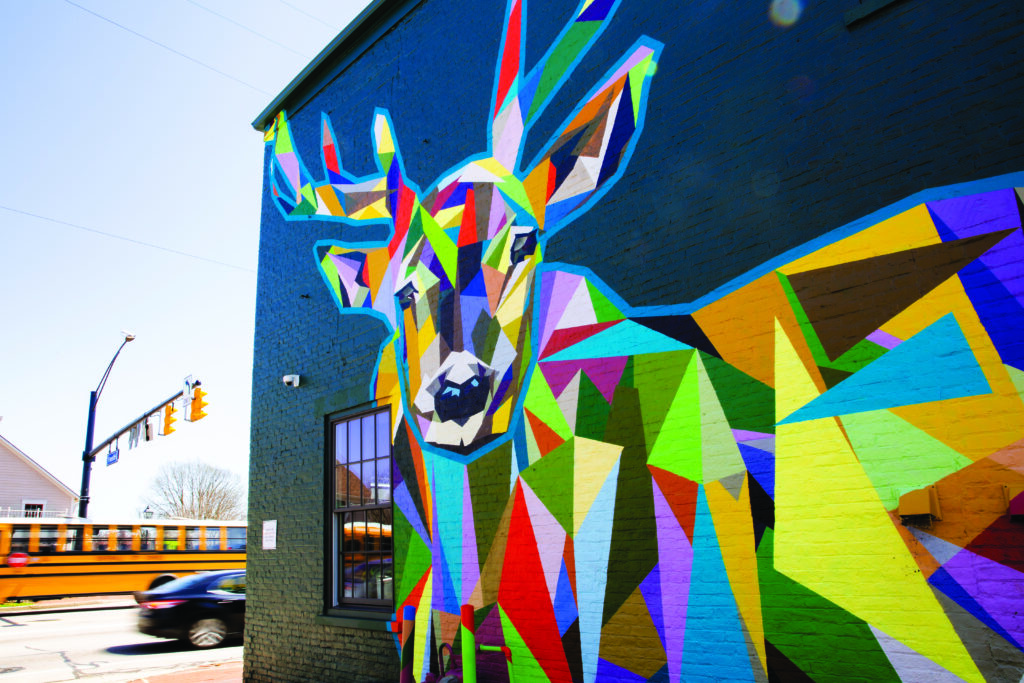
Downtown Dayton has enjoyed a mural program installing dozens of new works since the launch of the Greater Downtown Dayton Plan in 2010. The nonprofit organization that powers Dayton’s special improvement district, the Downtown Dayton Partnership, partnered with arts organizations like The Co and K12 Gallery & TEJAS to establish the Urban Art Intersections program. The collaborative effort secured grants to install public artworks that interacted with their environment. The result is creating a space where people want to visit—a real boon to surrounding businesses.
“Public art and murals create a sense of place and contribute to the culture of a city, which drives visitors and investment,” says Katie Meyer, president of the Downtown Dayton Partnership. “A vibrant art scene enhances the aesthetics of downtown and also promotes walkability within urban spaces.”
Big Ideas
The artists responsible for these gargantuan works must approach their medium differently than traditional fine art. There are proportions to consider, surface anomalies of the brick wall or underpass that serves as a canvas, and even the cost of paint is much greater for these larger works.
Tiffany Clark is perhaps one of the most prolific muralists in the region. Since the early 2000s, Clark has been leaving her mark—commissioned or otherwise—on the Miami Valley landscape.
“When you create public art, the main focus is the viewers. And since public art is seen by everyone, thoughtfulness and consideration for how one’s work affects its environment is most essential,” she says. “There have been several times I have had to convince the client to switch certain imagery so that the final mural will connect with its neighbors all the more.”
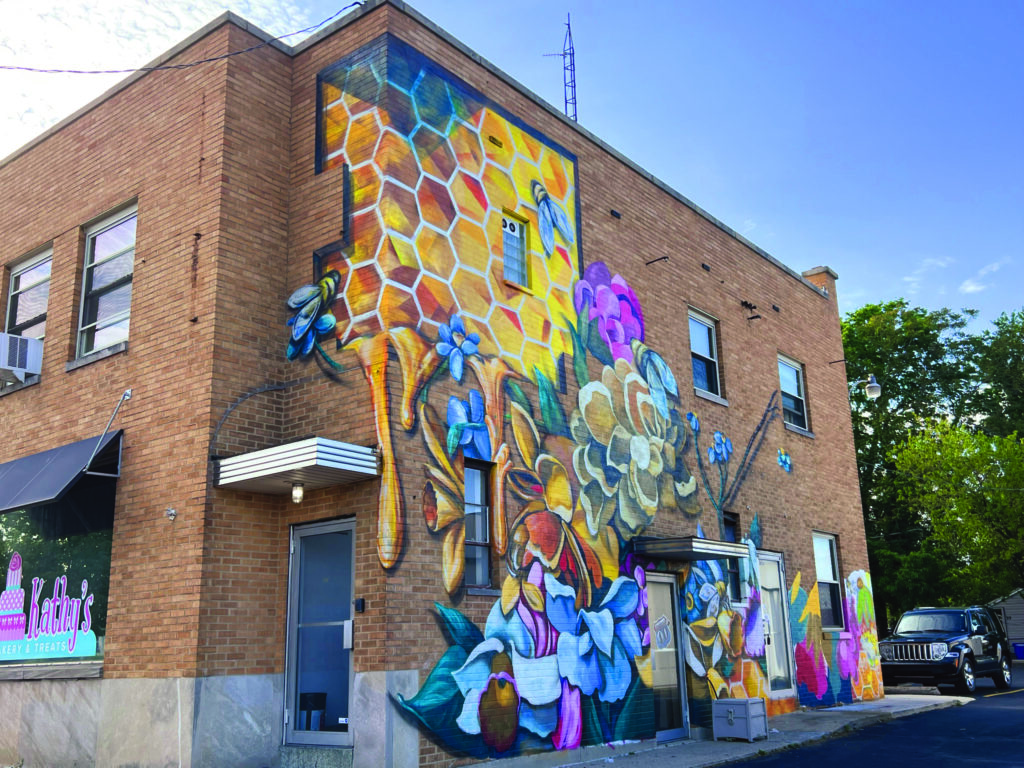
Jackson Stanard is relatively new to the mural scene, having created seven in the past three years. He is the lead muralist and public relations manager for K12 Gallery & TEJAS in Dayton. He says these installations are more than just individual acts of beauty. K12’s partnership with Montgomery County Juvenile Court Program, and its unique Juvenile Court Work Program, provides an opportunity for young offenders to learn accountability for their behavior and responsibility to the victims and community, while also learning positive work values and habits. Since 2013, the Helping Adolescents Achieve Learning Objectives (HAALO) team has been vital to local mural creating efforts.
“The HAALO team consists of a plethora of talented juvenile court adolescents who learn valuable skills that promote creation over destruction,” Stanard says. “The many murals we generate through our HAALO program will stand as testaments for the hard work and dedication that the teens and children have put into their creation.”
Personal Stories
Clark says her murals go beyond interesting graphic representation. Some of her murals have been about extremely sensitive topics.
“So many wonderful people in the community have shared their personal stories and tragic moments with me,” she says. “They have also shared how participating in a certain mural has been a therapy for them.”
A popular mural spearheaded by local artist Morris Howard and Montgomery County Juvenile Court’s Reclaiming Futures is the “Land of Funk” installation downtown on Stone Street near the Convention Center. Each panel depicts a different Dayton-based funk group. The music style introduced in the 1970s still has influence today, and the mural gave those painting and simply observing the mural something they could take pride in. “Art plays many important roles in our city,” Meyer says. “Art tells a story, reflects the creativity of our community, beautifies underutilized spaces and helps build connection to place.”
One powerful example Clark shared is about painting the “Love You” mural along Keowee Street in Dayton, which highlights loved ones lost to suicide as part of a larger awareness message. “Many times, individuals have come up and personally said how the mural saved their life during a moment of weakness,” she says. “I can’t imagine anything more gratifying than that.”
A Tall Order
Before an artist breaks out the projector and paints, the process of installing a mural typically begins with finding funds. Each installation can cost $10,000, up to more than $163,000 in the case of Dayton’s largest mural. That design by Amy Deal that graces the floodwall near RiverScape MetroPark is 16 feet high and nearly 1,000 feet long.
Once funding is secured, many mural projects in the Miami Valley begin with some kind of request for proposals. The Co manages the mural program in downtown Dayton and is responsible for marketing the requests to a larger audience of artists, ensuring as many working artists as possible have a shot at submitting their design. The designs are often narrowed down via committee of various stakeholders and possibly parties who contributed financially to the installation. Suffice it to say, there is a lot of thought and consideration that goes into each and every mural selection.
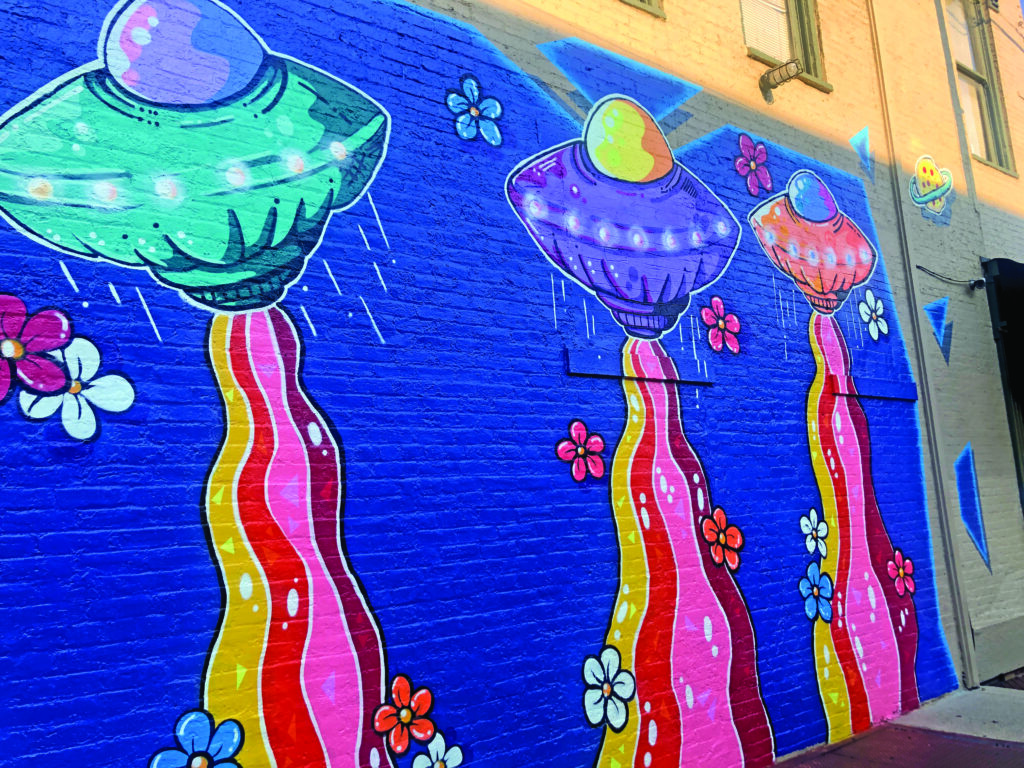
Buttacavoli says the end result—beautification and putting artists to work—is worth all the effort. “We champion the role of artists in our society,” she says. “Now, more than ever, we need artists to provide us with inspiration, creativity and imagination and to help us envision a better world.”
From there, the challenges become steeper—about 90 degrees steeper. Installation can be challenging, especially since projecting the image onto the surface tends to replicate better at night. Stanard says this process can be one of the trickiest aspects of mural installation.
“Without a doubt the biggest [hurdle] is replicating a design from a small scale to the significantly larger scale of the building,” he says. “Oftentimes we paint on surfaces that require us to be creative in our transfer process due to the abnormality of the buildings’ shape and size. Murals also require a significant investment in the highest quality paint and sometimes heavy machinery, such as forklifts and cherry pickers.”
Clark has a more organic approach to mural installation, and therefore her process is different with each project. “Sometimes you just see a vision, keep your fingers crossed and approach the [building] owner,” she says. “Every process for a commissioned piece is different depending on the location. Whether we are talking about investigating all of the permits or bureaucratic needs, or figuring out how to create the ideal image on whatever unique surface is given, each mural will give you a new curveball and a different lesson for next time.”
Stanard says until one has participated in a mural installation, the scale of the project can be difficult to grasp. “The amount of time and effort that goes into a mural is often misunderstood, no matter how big or small it may be,” he says. “It requires an investment of at least two months and can take up to six months to complete. Every mural we create requires a team of talented hardworking people that persevere through the process.”
For all their efforts, Clark reminds art lovers that communal beautification comes at a cost. “Signage and street art is one of the top 25 most dangerous professions in the country,” she says. “So remember, you’re not just paying us for our talent, our vision, time or our physical labor, but you’re also paying us to take a great risk to add color to the gray walls of our city in hopes to continually make Dayton a more beautiful place.”
The Broad Brush
At the end of the day, murals can spark joy, initiate discussion, pay homage to heritage, celebrate people and places, and generally enliven the streets where Miami Valley families live. Public art offers equitable access to original works, reinforcing the idea that art isn’t relegated to the walls of the wealthy.
“Art can and should be accessible to all people,” Buttacavoli says. “Each of us deserves a daily dose of inspiration.”
