

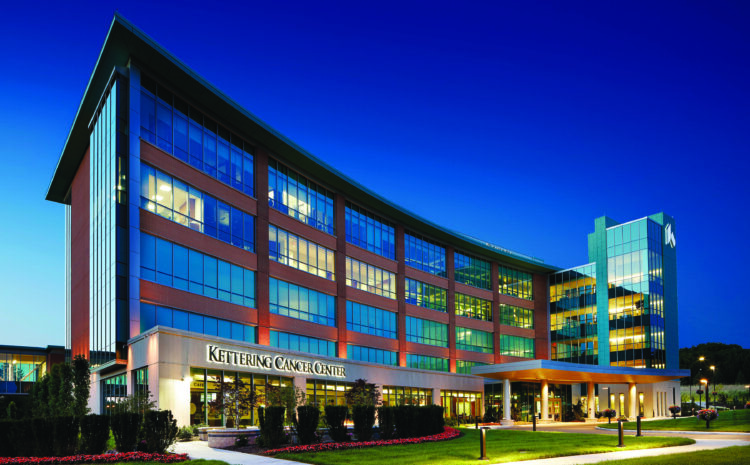
Kettering Health cancer care charts a future course
When it comes to diagnosing and treating cancer in Southwest Ohio, or for that matter the entire nation, few medical organizations can rival the care offered by the Kettering Health Cancer Care.
This is one organization that is not resting on its laurels, despite the challenges to cancer care caused by COVID-19. In fact, Kettering has been able to evolve throughout the pandemic and is now well-positioned to not only handle an influx of new patients but has also expanded its services beyond cancer care into what can only be described as complete holistic care.
Kettering Health is also well positioned for future advances in cancer treatment at the molecular and genetic level—a brave new world that will revolutionize care as well as the way the medical community thinks about, diagnoses and treats cancer.
Best of all, with four major cancer treatment facilities across Southwest Ohio, Kettering Health is uniquely positioned to make its world-class cancer care easily accessible across our region.

“We have four major cancer care centers,” says Kenneth Chaij, executive director of Oncology for Kettering Health Cancer Care. “Troy is our northern most, then we have one in Beavercreek at Soin Medical Center, our comprehensive center at Kettering Health Main Campus and the farthest south at Kettering Health Hamilton, which is in the northern suburbs of Cincinnati.”
And each of those facilities is integrated with the others, which means you can see a doctor and receive treatment at one, and then receive the same continuum of care at other facilities if it is more convenient. This allows for more patient choice, easier access and more timely diagnosis and treatment.
Perhaps more importantly, Kettering has expanded its integrated program to include treatment that goes well beyond cancer care.
“We have had treatments like massage and acupressure, but we have expanded that to include classes and support groups,” says Chaij. “That includes issues around sexual health. As a man or woman has different procedures, therapies or physical changes from surgeries, they may also experience changes in their perception of themselves. If they are in a relationship, this can cause stress and other issues.
“So we walk them through things and help them overcome concerns and some of the awkwardness than can arise. We are the only organization in Greater Dayton or even the Southwest Ohio region that offers this kind of support, not just for the patient, but for their spouses or significant others.”
These offerings go a long way toward an individual having a positive self-image and worth, which are both keys to the healing process. It’s also a part of Kettering’s mantra when it comes to cancer care: constant improvement and reflection on the continuum of care.
“We are always looking at things that aren’t normally available and that we don’t currently have, but we can provide,” says Chaij. “Cancer care is more than just therapy. We have to look at it holistically, which is our whole approach to patient care. We offer a very faith-based holistic medicine. We are constantly asking ourselves what we can do to help our patients and not lose our focus on them.”
The breast evaluation center at Troy Hospital is an excellent example of the approach. This first-of-its-kind facility to women’s health was opened in the spring of 2021. In addition to the most technologically advanced screening and diagnostic services that include mammography, breast ultrasound, DEXA scan, breast biopsy and risk assessment, the center offers a SensorySuite in the mammography room that includes relaxing images, sounds and even fragrances designed to reduce anxiety and increase comfort.
And it’s been a huge success.
“We are seeing a lot of women there and have found a number of cancers in patients that we have been able to bring into our comprehensive program, catching them as early as possible, for treatment,” says Chaij.
This is true not just at Troy, but at all Kettering Health Cancer Care facilities, which is especially important with the pandemic on the wane. It’s certainly no secret that, out of fear, many people put off seeking treatment during COVID-19. Now, their cancer may be more advanced and diagnosis and treatment all that much more critical.
“We also know that there are still people out there who are hesitant or fearful and have put off screening and education, not just for breast cancer, but for cancer patients across the board. People have been putting off lung screenings, colonoscopies and mammograms. So we are seeing people with more advanced cancers.”
Doesn’t that put a lot of pressure on Kettering? Not really, says Chaij. In fact, Kettering Health addressed potential future problems during the pandemic—expanding its services, and meeting with its physicians, caregivers and support staff to be prepared to get patients into treatment as quickly as possible.
“Because their cancers are often more advanced, we know we have to move them in quickly,” says Chaij. “We know that we can’t do things as we once did, which was already fast. We often have to get these people turned around in a day or two, making sure they see all the physicians they need to see and getting them into treatment as quickly as possible.”
Over the past two years, Kettering Health Cancer Care has improved its coordination processes among family doctors, primary care physicians and its oncologists and physicians by using technology.
“Coordination between what we do, which is often very specialized, with primary care physicians is very important because they can help us manage an individual’s health needs,” says Chaij. “We send reminders of treatments and consultations by text or email. We are also offering telehealth, where you can connect with us via phone, or through a phone in your primary caregiver’s doctor office to connect with the specialists here. And we will walk you through the entire process.”
But more important than anything, if you suspect something is wrong, you need to get into your primary caregiver to discuss your symptoms, Chaij stresses.
It’s easy to see that the Kettering Helath Cancer Care is one of the most experienced hospital programs in the Dayton area. But the future of cancer care is already on the organization’s horizon. Cancer treatment is evolving dramatically—and Kettering Health is right at the forefront.
“We know the role that genetics will play in cancer treatment in the next five years,” says Chaij, “and we are strategically planning to deliver molecular science and molecular treatments right here in Dayton.
“We are at a point where cancer isn’t going to be defined so much as where it’s located in the body, but rather how it is defined based on its mutations in the individual. So in the future, cancer will be treated specifically for an individual’s needs.
“We are using the term personalized precision medicine, which translates down to targeted tumor therapy.”
Yet another brave new world, where hopefully the scourge of cancer can be cured.
