

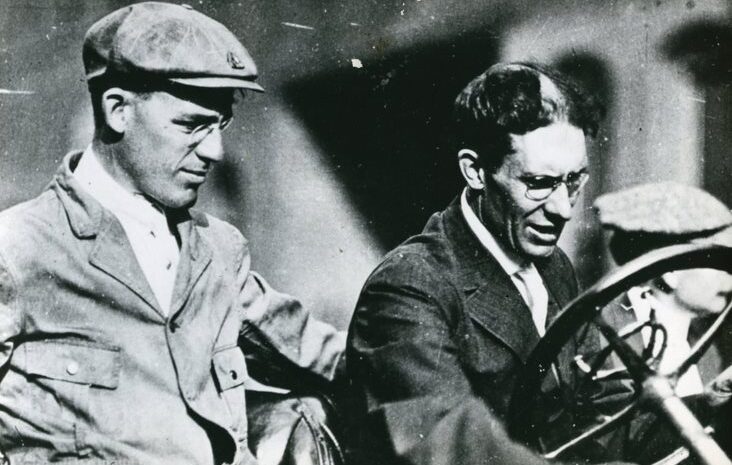
Bill Chryst, an often-unsung member of The Barn Gang, made his mark on Dayton and the world
The neighborhood of Grafton Hill stands north of a dogleg bend in the Great Miami River, a historic area teeming with muted prosperity. A half-mile northwest of The Dayton Art Institute, the community, with its Tudor, Neoclassical and Jacobethan homes, hearkens to a time when horse hooves echoed across Dayton city streets.
Near the north end of Grafton Hill, on Central Avenue, scattered pines rise from a 9,000 square-foot vacant lot. However, this plot wasn’t always empty. The land at 319 Central Ave. was once occupied by a Queen Anne-style home. In the backyard, under the branches of the pine trees, stood a quaint carriage house. In the early 20th century, a brilliant inventor and a band of young engineers toiled countless hours in this carriage house, a building affectionately nicknamed “The Barn.”
A River of Gold
In 1904, Charles Kettering was hired at National Cash Register (NCR) by a tidy, even-keeled man, his hair neatly parted down the center, his pince-nez glasses sitting atop his Roman nose. Kettering’s appearance was much the opposite—he was lanky and disheveled and peered through thick glasses that aided his historically terrible eyesight. But Edward Deeds saw Kettering’s potential, and recruited the engineer in the NCR Inventions 3 Department.
Deeds had foresight. While working at NCR, Kettering electrified the cash register, eliminating the need for a hand crank. Deeds wondered if similar technology might be applied elsewhere. In order to start an automobile, operators once had to turn a cumbersome hand crank on the vehicle’s front end. Accidents occurred and arms were broken. Perhaps Kettering’s brains could be applied to the car—if the inventor could successfully eliminate the automobile hand crank, there may be a fortune waiting.
“There is a river of gold running past us,” said Deeds to Kettering. “Why don’t we throw out a little dam and sluice some of it our way?” Kettering quit his job in the NCR Inventions 3 Department and went to work for Deeds full time.
At his 319 Central Ave. home, Deeds transformed “The Barn” into a workshop. Kettering and his group of young engineers—“The Barn Gang”—then invented the starter-motor and drove the automobile into the 20th century.
Without Deeds’ vision, and Kettering’s inventive genius, The Barn Gang would have never existed. But without a team, Deeds and Kettering would have been a mere barn duo. Many talented tinkerers joined The Barn Gang, but Deeds and Kettering’s first recruit always held the highest rank. Tall and trim, sometimes seen in a flat bill hat, William A. “Bill” Chryst was talented, sincere and sound in judgment.
Enter Chryst
Chryst, the son of a cabinetmaker, landed his first job at Baker Hardware Store on Fifth and Jackson at age 14, working for $2 a week (roughly $60 a week in 2021). Later, NCR founder John H. Patterson hired Chryst as an office boy at $3 a week, but the young man had bigger ambitions. After enrolling at the YMCA Night School (later known as Sinclair Community College), Chryst was promoted to NCR assistant foreman at age 24. The promotion was fortuitous.
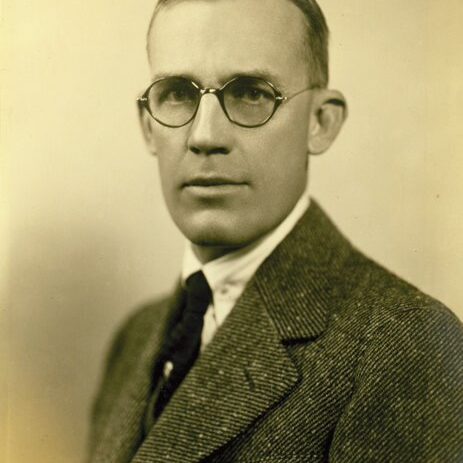
In 1904, Charles Kettering arrived at NCR to oversee the Inventions 3 Department and Chryst became his first assistant. Kettering, an idea man, relied on Chryst to find practical applications for his notions. The pair worked together designing drawer-operated cash register systems for banks, hotels and department stores. When Kettering began working at Deeds’ Barn full time, Chryst succeeded him as head of Inventions 3. But Chryst wanted a piece of the auto action.
Volunteering after hours, on weekends and holidays, Chryst was in a prominent position when Kettering and the Barn Gang saw success. When it was time to go into business, Deeds suggested naming their new enterprise The Dayton Laboratories and Engineering Company.
“Not so good,” replied Chryst when Kettering asked him what he thought of the name. “Why don’t you change the words around and call it The Dayton Engineering Laboratories Company.” The name stuck. Chryst abbreviated the moniker to DELCO, a name now synonymous with motorcar history.
In 1910, Chryst left NCR and became chief engineer at DELCO. Soon he moved from his 901 Shafor Blvd. home in Oakwood—at the corner of Wisteria and Shafor—to 999 Harman Ave., right next door to Orville Wright and Hawthorn Hill.
Up and Up
In 1917, some five years after the Barn Gang completed their work, the nation entered World War I. During the Great War, Chryst worked as an ignition expert under famed General of the Armies John J. Pershing. (Only two people have been named General of the Armies, Pershing and General George Washington). The following year, 1918, Chryst, age 41, began working alongside Kettering on a pilotless missile, the predecessor to the “Bug”—the first pilotless plane to transport an explosive. Thankfully, the Armistice put an end to their efforts.
A decade later, in 1928, the Soviets purchased a number of Liberty airplane engines from the United States, and Chryst, age 51, traveled to Russia to oversee the testing and servicing of these lightweight, powerful engines. During World War I, the Dayton-produced Liberty engine was America’s most significant technological contribution, and Chryst became a valuable consultant.
Chryst’s consulting work continued. In 1931, at age 54, he became a DELCO consulting engineer. Some 16 years later, on January 15, 1947, Chryst retired from DELCO, the company he named, at age 70.
Unique Industrial Muscle
Throughout his life, Chryst served as an international diplomat, and was heavily involved with the Engineers Club of Dayton. The organization, founded by Edward Deeds and Charles Kettering, counted Orville Wright as a key member and, from 1925 to 1926, Chryst served as president.
Chryst lived out his days in Dayton next door to Orville, volunteering and supporting various community organizations. On June 4, 1858, Chryst died in Dayton, Ohio, the only home he ever knew.
“William A. Chryst was one of a tiny, remarkable band of inventors and innovators who gave Dayton its unique industrial muscle,” wrote the Dayton Daily News on June 5, 1958. “His death last night at 81 removes from the Dayton scene one of a small group who had enormous influence in making that scene what it is today.”
But Bill Chryst’s impact spread far beyond Dayton. While his name might not be as prevalent as the Wright brothers, Charles Kettering or Edward Deeds, the great engineer’s contributions are still felt around the world, rumbling with each turn of a starter motor and echoing each time the word “DELCO” is uttered.
