

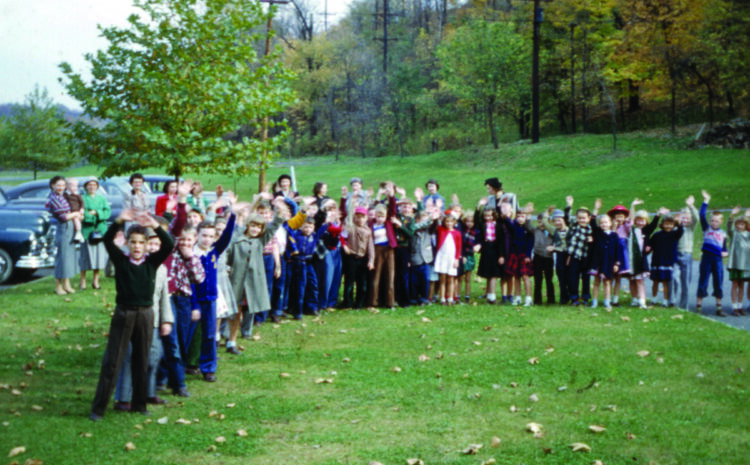
When Carillon Park opened in 1950, the museum featured eight original attractions, including the world’s first practical airplane
By 1950, Dayton, Ohio, had changed the world. When it came to innovation—and transportation innovation, in particular—the city was unparalleled. So in the late spring of that year, Col. Edward A. Deeds, a former NCR executive, core member of Charles Kettering’s Barn Gang (the scrappy group that invented the starter motor), and co-founder of Delco, honored his city by opening Carillon Park, a 65-acre open-air museum celebrating Dayton’s unique contributions to transportation history.
Designed by the Olmsted Brothers, the sons of Frederick Law Olmsted, the landscape architect responsible for Central Park, Carillon Park unveiled on Saturday, June 3, 1950, under wet skies. “Showers … cooler today and tonight,” forecasted the Dayton Daily News that morning, “high today, 72; low tonight, 58.” But dark clouds couldn’t keep visitors from Dayton’s newest attraction.
From the onset, the crown jewel of Carillon Park was the 1905 Wright Flyer III, the world’s first practical airplane. The 1903 Wright Flyer offered proof of concept, but it was the ‘05 Flyer—the machine the brothers considered their most important aircraft—that became the world’s first practical airplane.
And while Carillon Park opened over two years after Orville, the younger Wright brother and the world’s first pilot, died, plans for the museum were in motion throughout the 1940s. Orville, a close friend of Deeds, not only had a hand in resurrecting the Wright Flyer III but also in designing Wright Hall, the building where the famous plane would be displayed.
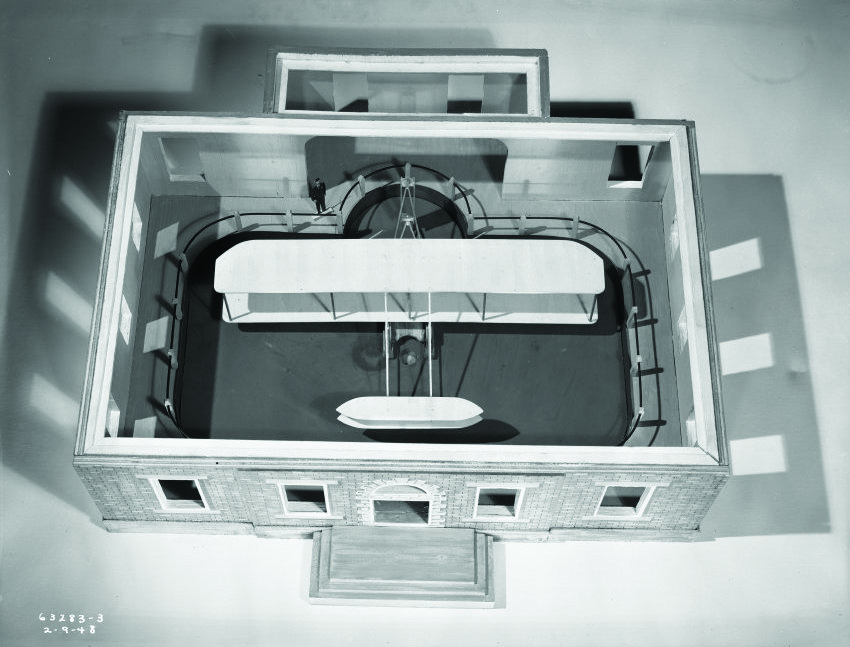
Restoring the 1905 Wright Flyer III for Carillon Park was the first pilot’s last project. But it wasn’t the only feature of Dayton’s new historical museum. When Carillon Park opened, it featured seven other original attractions.
The 1835 B&O #1, John Quincy Adams
Carillon Park, the home of the world’s first practical airplane, is also home to the 1835 B&O #1, John Quincy Adams, the oldest-existing American-made locomotive. But the JQA’s presence at Carillon Park is a stroke of luck.
Since Dayton’s first railroad tracks were laid in 1851, Deeds, appropriately, asked the Baltimore & Ohio Railroad, America’s first commercial railroad, to help him find a mid-19th century locomotive. B&O, unable to honor Deeds’s request, instead offered him what they called “The Traveler.” At the time, The Traveler seemed a consolation prize, but when Deeds brought it to the B&O Mount Clare Shops in Baltimore for restoration, he learned that he had actually purchased the John Quincy Adams.
The 1843 Conestoga Wagon
Built between 1811 and 1834, the National Road, the country’s first federally funded road, connected Americans to the west. Now known as Route 40, the National Road cut through the heart of Ohio, and Deeds honored this piece of the region’s past by purchasing an 1843 Conestoga wagon. Built in Pleasant Unity, Pennsylvania, Carillon Park’s Conestoga wagon helped haul rations to hungry workers (and horses) as they built the Pennsylvania Railroad. Originally housed in the Wagon Shed, the 1843 Conestoga wagon was once accompanied by the 1870 Concord stagecoach.
The Grist Mill
Modeled after Staley’s Mill, an 1818 mill near New Carlisle, Carillon Park’s gristmill honors pre-electricity, water-powered Ohio. Originally built as a residence for the park’s caretaker, the Grist Mill is now home to a retired police officer who keeps watch over the museum.
Smith Covered Bridge
Designed by Robert W. Smith, a Miami County bridge builder, this Warren-truss-style bridge originally spanned across Little Sugar Creek off Feedwire Road in Bellbrook.
Miami and Erie Canal Lock #17
Built in 1833, Miami and Erie Canal Lock #17, one of 106 regional canal locks, once stood in Wayne Township near present-day Huber Heights. The Miami and Erie Canal, which connected Cincinnati to Lake Erie, ran for 248 miles, cutting through the site of Carillon Park, right where Lock #17 now stands.
Corliss Engine Building
Originally housed at NCR, the Corliss Steam Engine powered, and heated, the company’s 30-building campus for 46 years. Built in 1901 in Mount Vernon, Ohio, by C&G Cooper Company, the 210-ton Corliss Engine had to be pulled to NCR by a team of horses. When the engine was brought to Carillon Park, Deeds housed it inside a replica of an old NCR building. Sandstone brick with high windows, these cream-colored NCR buildings once dotted much of south Dayton.
Deeds Barn Replica
At his 319 Central Ave. home in Dayton’s Grafton Hill neighborhood, Edward A. Deeds transformed his carriage house, or “barn,” into a workshop. Inside this storied building, Deeds, Charles F. Kettering and a group of young engineers—“The Barn Gang”—invented the starter-motor and drove the automobile into the 20th century.
When Deeds was designing Carillon Park, he considered moving the original barn to the museum, but time and termites had taken their toll on the building. (Plus, the barn’s owner possessed a questionable title). So Deeds decided to build a replica. Then, in 2009, nearly 60 years after the museum first opened, the original Deeds Barn was finally moved to Carillon Park. (No, you’re not seeing double. There really are two Deeds Barns at Carillon Park. The one outside is a replica, while the one inside the Heritage Center of Manufacturing and Entrepreneurship is the original).
Leo DeLuca’s work appears in The New York Times, Smithsonian Magazine, Scientific American, Rolling Stone, Popular Science and Pitchfork, among other media outlets. DeLuca, an award-winning writer, holds a Master of Arts in Science Journalism from Columbia Journalism School and a Bachelor of Science in Education from Ohio University.
