

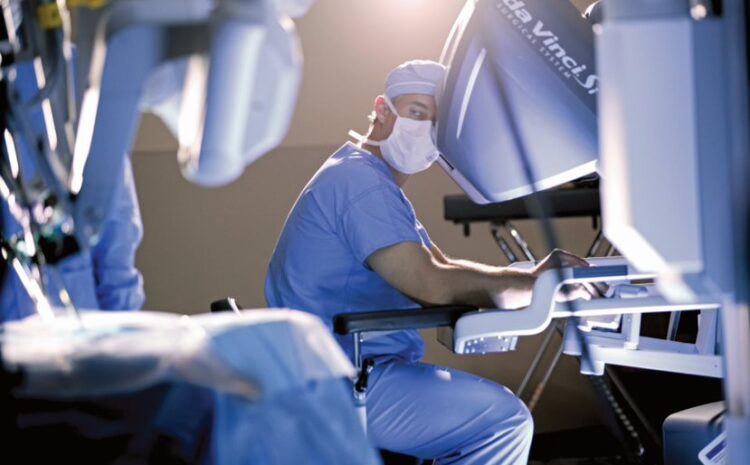
Miami Valley residents can access the newest and best cancer treatments within the region
While some say the pasture is always greener on the other side, they would be mistaken to say that about cancer care in the Miami Valley. Without leaving the region, you’ll find the newest advancements in screening, diagnostics and treatment. You’ll also find technology that’s unique to the region, and even the state, right here.
Screening & Prevention
When it comes fighting cancer, it all starts with screening and education.
“There are multiple opportunities to prevent premature death,” says Dr. E. Ronald Hale, the medical director for the department of radiation oncology at the Kettering Health Network. “Those opportunities include preventing the disease from happening in the first place, such as getting a patient to quit tobacco use or having a patient receive something like the Gardasil vaccination and screening for the disease when it is not yet manifested itself clinically.”
Hale says this all starts with the education of patients through their primary care physicians.
“Those things are really important because they’re relatively simple, but they can touch to a lot of people,” he says. From there, Kettering Health Network moves patients into screenings, such as mammograms and colonoscopies. Hale says that Kettering has made this easy for patients by expanding access to state-of-the-art technology. For example, Kettering offers its mammography screening in breast evaluation centers at all of its facilities.
Premier Health, which is the only certified member of the MD Anderson Cancer Network in southwest Ohio, also emphasizes the importance of screening, prevention and education.
“We can have all the screening programs in the world, but people have to believe that they’re necessary for them,” Dr. James Ouellette, chief of surgery and director of the hepatobiliary and pancreatic surgery program at Premier’s Miami Valley Hospital.
Premier’s Cancer Prevention Program is one way the health system is working to address this. After answering a series of questions with their primary care physician or OB-GYN, a patient may be recommended for genetic counseling and a DNA test.
“The DNA testing is a good way for people to get a screening program to at least identify patients who really need it and convince them that they really need to go for that colonoscopy,” says Ouellette.
The test checks for 35 different genetic mutations and can help patients determine their risk for a variety of cancers.
Another screening program recently launched by Premier is its Fast Breast MRI.
“It allows the woman or man who is getting a breast MRI done to be able to be on the table for less amount of time. And it’s a less expensive option, but still produces the same high quality results,” says Mikki Clancy, chief digital officer for Premier. Because the service is not covered by insurance, Clancy says it’s a great option for the under-insured or those without insurance. Premier Health is the first in Dayton to offer this self-pay alterative in four locations.
Treatments & Technology
Kettering and Premier both have access to state-of-the-art treatments that you may not find elsewhere.
Kettering for example, has a cyclotron in its Molecular Imaging Center of Excellence.
“A cyclotron is a device that is able to make radioactive isotopes that can be used to perform certain types of PET imaging. PET imaging is a very exciting technology that utilizes the typical traditional CT scan, but on top of that, it is accompanied by an injection, a very small injection, of some form of a radiotracer,” says Hale.
Hospitals throughout the country use this technology to detect cancer throughout the body, but Kettering, thanks to its cyclotron, can make a radioisotope called methionine that allows doctors to see tumors in the brain, something that is harder to detect on a regular MRI.
“There’s no other place in the region, or the state for that matter, that has the ability to do this type of imaging,” says Hale.
Last summer, Premier became the first health system in Ohio to install the Monarch system, which is used to search the delicate areas of the lung and obtain samples for hard-to-reach nodules.
“So many times they’re not able to get to where the lesion is to remove it or biopsy it,” says Clancy. “This allows us to actually go in and biopsy those very quickly. It’s almost like a computer controller. They can really see down into the area where the tumors are and they can remove them when they’re much smaller so that they don’t get further in there.”
A Personal Touch
As treatments and technology continues to improve, so is the patient experience as a whole. Both Premier and Kettering are looking for ways to make the process easier on patients.
At Premier, an example of this is the Liver Cancer Center of Ohio. The center brings together oncologists and radiologists so that they can work together to treat patients with liver tumors. “We’re trying to maximize patient’s time and to get the answers as quickly as we can for people and then also decide and make treatment decisions,” says Ouellette.
At Kettering, the multidisciplinary prostate clinic does something similar, bringing oncologists and urologists together to treat prostate cancer.
“The prostate multidisciplinary clinic was a pilot that established the process and it’s been very successful. We anticipate rolling that out to other sites to include breast and gynecological malignancies and others in the very near future,” says Hale.
Ultimately the goal of all health care providers in the Miami Valley is to provide the care care patients needs close to home.
“We want to treat cancer here at home wherever possible,” says Clancy. “There is just a tremendous amount of anxiety that comes along with cancer, and then adding travel on top of it is just something that’s not really necessary.”
Want to learn more about the region’s cancer care? Click here to learn about another regional cancer care provider, the Dayton Physicians Network.
