

Local father-son team is leading the way for ultra-efficient AI
There’s nothing artificial about the intelligence of these two. In fact, they are leading the way in terms of creating revolutionary AI to use less energy and become more efficient. They live right here in the Dayton area, but they are taking their innovation and brain power to the stars.
In a world dominated by cutting edge technology and massive data centers that use even larger amounts of energy, it’s the father-son team of Steven D. Harbour, director of AI Hardware Research at Parallax Advanced Research, and his son, David A. R. Harbour, an electrical engineering student at the University of Dayton, who are pioneering the use of brain-inspired artificial intelligence (AI). Also known as neuromorphic computing, this technology is key to the successful future implementation of AI.
With computational demands of state-of-the-art AI algorithms today requiring as much as 190,000 kWh, it easy to see that the primary problem with AI is its high energy consumption. AI power use alone, especially in larger data centers, is already starting to strain the available supplies of energy in many parts of the world—which will ultimately lead to price increases and even widespread outages.
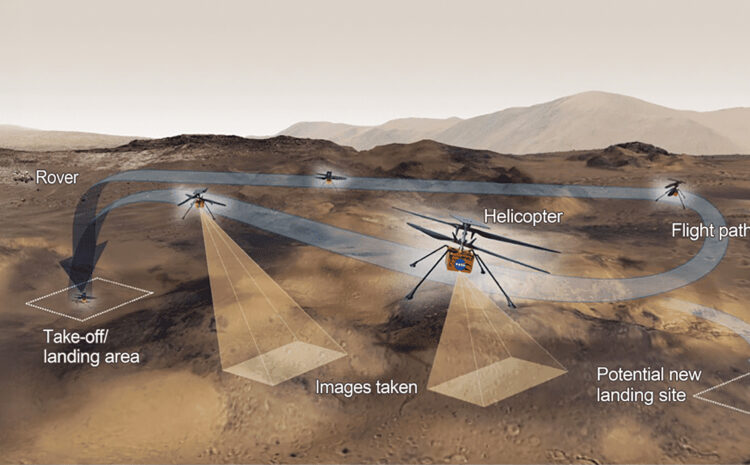
While developing that kind of power resource in space or planets like Mars is impractical if not impossible, AI is essential, especially when it comes to powering the next generation of planetary flight.

Together, David and Steve have authored multiple scientific papers on Martian drone navigation and are developing technologies that could soon guide autonomous explorers across the surfaces of Mars and the Moon.
“It’s exciting to know that the research we do here in Dayton could one day help a drone fly on Mars,” Steven says.
“I’ve always been fascinated by space. Working with my dad on AI for real missions — that’s a dream come true,” adds David.
So what’s it like to have your son follow in your footsteps and to be known as the “wiz kid and his wiz dad?”
“It’s incredibly rewarding—and sometimes humbling,” says the elder Harbour. “David and I both research neuromorphic AI, an exciting field that draws inspiration from how the human brain processes information.
“Watching him grow from student to lead author on two published Martian drone navigation papers has been one of the proudest moments of my career. We collaborate as colleagues now.”
From a very early age, David was fascinated with both electronics and flight. “He grew up around my projects and labs and attended air shows with me,” says Steven. “What truly ignited his interest was NASA’s Ingenuity Mars Helicopter. That inspired him to pursue electrical engineering with a focus on neuromorphic AI for space exploration.”
Why does a vehicle or helicopter need AI (and energy-efficient AI at that) on Mars?
It all comes down to distance. A radio signal traveling from Earth to Mars can take between 3 and 22 minutes to travel to Mars, depending on the distances between Mars and Earth due to their respective orbits. Controlling a helicopter from Earth at that distance becomes impractical, even when the delay is only 3 minutes.
A Martian helicopter would need to make adjustments in real Martian time, like speed, flight path, elevation, weather and distances to destination, in order to be an effective means of exploration. Using AI would enable the drone to deliver those kinds of navigational determinates in real time on the planet’s surface.
But then there comes the problem of power. Using today’s standard AI models, you would need to create a power supply on Mars that could deliver massive amounts of energy in order for the helicopter drone to operate. Hence, the need for neuromorphic computing, which needs only 10 to 20 watts of power to achieve over 240 trillion operations per second.
Scaling back on power use of AI for operations confined to our own planet is also essential for the technology’s ultimate use and growth. Thus the need for scientists like the Harbours who are leading this computing revolution is evident.
As director of AI Hardware Research at Parallax Advanced Research, Steven Harbour has more than 26 years of experience in neuromorphic computing,
Neuromorphic computing delivers the kind of fast, efficient and adaptable computations necessary for other applications like electronic warfare, ISR (intelligence, surveillance and reconnaissance) sensor processing, autonomous navigation, satellites and advanced sensor fusion. And because it mimics human thought and decision-making processes, it’s very practical.
“At Parallax Advanced Research, I’m leading projects in neuromorphic computing for aerospace applications, including DARPA initiatives,” says Steven, “Our team is exploring ultra-efficient AI for planetary drones, edge navigation for lunar landers and cognitive RF (radar frequency) perception for next-gen electronic warfare. David and I are also co-authoring another NAECON 2025 paper on spiking neural networks for Martian and lunar flight.”
As an undergraduate electrical engineering student at the University of Dayton, David also focuses on neuromorphic computing, authoring multiple research papers on Martian drone navigation using AI systems that operate on ultra-low power while using spiking neural networks.
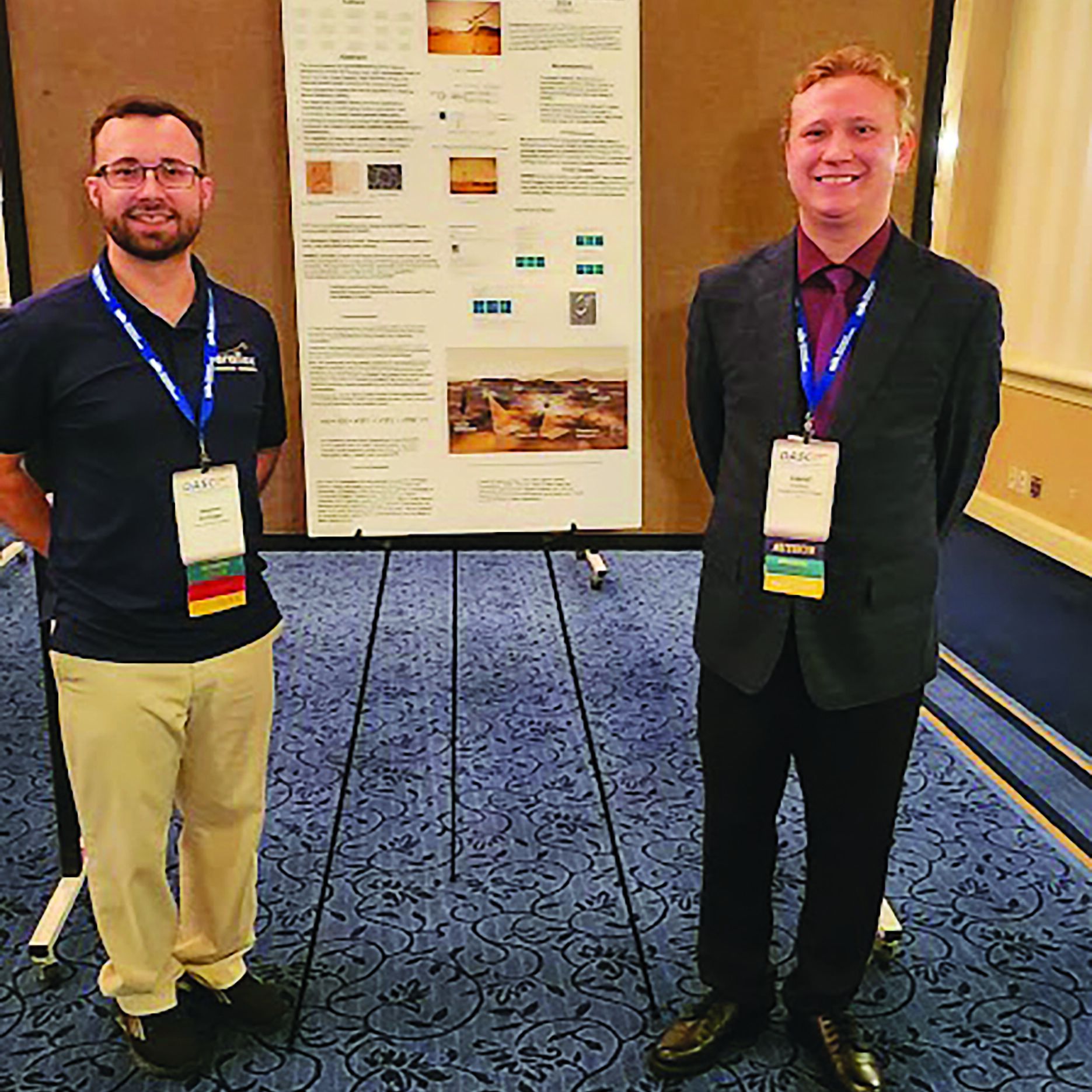
At the Digital Avionics Systems Conference (DASC) in San Diego last year, David’s paper (sponsored by Parallax), demonstrated a significant leap forward for neuromorphic computing, earning recognitions for the transformative contributions to the exploration of space. The title of the presentation was “Martian Flight: Enabling Motion Estimation of NASA’s Next-Generation Flying Drone.”
The project was honored as a Top Finalist in the Student Lead Author category.. The award acknowledged the significant potential of neuromorphic computing solutions, particularly in overcoming the challenge of self-velocity estimation in Martian environments where GPS is unavailable.
The initiative, done in collaboration with Parallax and NASA as well as Ohio-based universities, demonstrated the use of neuromorphic systems in extreme environments and illustrated the Harbours’ commitment to advancing neuromorphic computing for practical applications, particularly in overcoming the challenges of self-velocity in Martian environments.
By utilizing a neuromorphic event camera that offers advantages in speed, energy efficiency and visual processing, paired with spiking neural networks (SNNs), the paper proposed how neuromorphics would enable autonomous navigation for NASA’s Mars helicopter drone, allowing it to make complex decisions autonomously.
“Even the very best static camera cannot perform as well as a neuromorphic camera,” says Steve. “There’s low energy use coupled with neuromorphic spiking within a system and you do not have to come all the way back to earth to perform any high latency operations. For instance, how does a drone figure out what its speed should be?
“Additionally, a standard camera will blur when you use LiDAR (light detection and ranging) and look straight down at the ground. Even the best high-speed cameras will blur, while a neuromorphic camera will not—it behaves more like a human eye coupled with your brain.”
In future interplanetary missions, these capabilities reduce the need for Earth-based monitoring and present an innovative solution to longstanding limitations in interplanetary space exploration. While traditional computing approaches struggle with the demands of such applications, autonomous, adaptable and energy-efficient systems using neuromorphic computing are key.
And while the technology is key to future interplanetary exploration of our solar system, it could also be an underlying technology that drives the revolution and use of AI across multiple industries and platforms here on Earth. The promise of neuromorphic computing will eventually expand into virtually all fields of scientific endeavor. While it’s certainly exciting work, for the Harbours, it’s more than just academics—it’s about shaping the future.
“It’s exciting to know that the research we do here in Dayton could one day help a rover navigate the surface of Mars or a drone fly through the shadowed craters of the moon,” says Steve. “And to be doing that with my son—there’s nothing better.”
