


Kettering College debuts new program and lowers costs to address nursing shortage
Southwestern Ohio, like much of the country, has been experiencing a nursing shortage for years. In a study done by the American Nurses Association, researchers project that the United States will need 1.2 million new registered nurses by 2030 to meet demand.
Kettering College in Kettering is doing what it can to help the region have more well-qualified nurses by developing a new degree program, doubling the numbers of students it accepts each semester, lowering its tuition and adding more scholarships and grants than ever before.
“The pandemic has highlighted the need for well-trained, compassionate bedside nurses, and by expanding our nursing program, we hope to bring more people into the profession as soon as possible,” says Paula Reams, RN, PhD, dean of Nursing at Kettering College. “Our four nursing tracks provide options for people in many stages of life, with added flexibility to fit their educational pursuits around their job and family responsibilities.”
Kettering College’s newest program is its full-time, accelerated Bachelor of Science in Nursing (A-BSN) track. Those who have earned a bachelor’s degree with specified prerequisite courses, such as statistics and chemistry, can earn their degree in four semesters, the equivalent of 15 months.
“Our A-BSN will be delivered in two seven-week sessions for four consecutive semesters and feature the same curriculum as our other BSN tracks,” says Reams. “It’s an intensive course of study with classes and clinicals that will keep students very busy six days a week—so busy that we advise not having a job outside their schooling. The payoff is that students earn a BSN degree very quickly, in what we expect will continue to be a very hot job market for nurses.”
The A-BSN joins Kettering College’s three other Nursing degree track programs:
– A prelicensure BSN (P-BSN) that is ideal for high school graduates or transfer students. The program can be completed as a full-time program in three years or as a part-time one over three years.
– A Licensed Practical Nurses (LPNs) to BSN track, which enables those who provide basic nursing care to earn their bachelor’s degree. This can also be completed as a full-time program in three years or as a part-time one over three years.
– An online Registered Nurse (RN) to BSN track for current working nurses with an associate degree or equivalent who want to earn their bachelor’s. Students can take up to five years to complete the program.
With the addition of the new Nursing degree track, Kettering College is planning to double the number of nursing students it admits each year to 250, enabling Kettering College to train even more nurses to help meet the region’s demand.
“The college has long been a pipeline for employment at Kettering Health,” says Jennifer Schull, MHA, BSN, RN, executive vice president and chief nursing officer at Kettering Health. Kettering College, which is located on the Kettering Health Main Campus, has always enjoyed a close relationship with Kettering Health. “We hire hundreds of nurses a year at our 13 hospitals and outpatient centers, and in 2021 more than half of them were new Kettering College nursing graduates. We will always have employment opportunities for Kettering College grads who share our spirit of service.”
In addition to expanding the program, Kettering College is also working to make earning a nursing degree more affordable. In the online RN-to-BSN program, nursing students who work at Kettering Health 20 hours a week receive a 30% tuition discount and a $7,000 annual tuition credit. The cost of the online degree program has also gone down—from $593 per credit hour to $395.
“Students see the value of Kettering College because of our connection to Kettering Health Network,” says Adam Brown, dean of Student Success. “They know they’ll have opportunities to pursue a career in a thriving, faith-based health network that shares their passion for service.”
While the addition of more nurses will surely be a boon to the region’s hospitals, it also promises to have a positive impact on the region’s economy and the lives of individuals earning the degrees. According to the college, nurses entering the Dayton market can expect and average starting salary of $65,000.
“Kettering Health will always be looking for nurses who have a heart for serving others, practice exceptional care and exhibit God’s love with every interaction,” says Schull. n
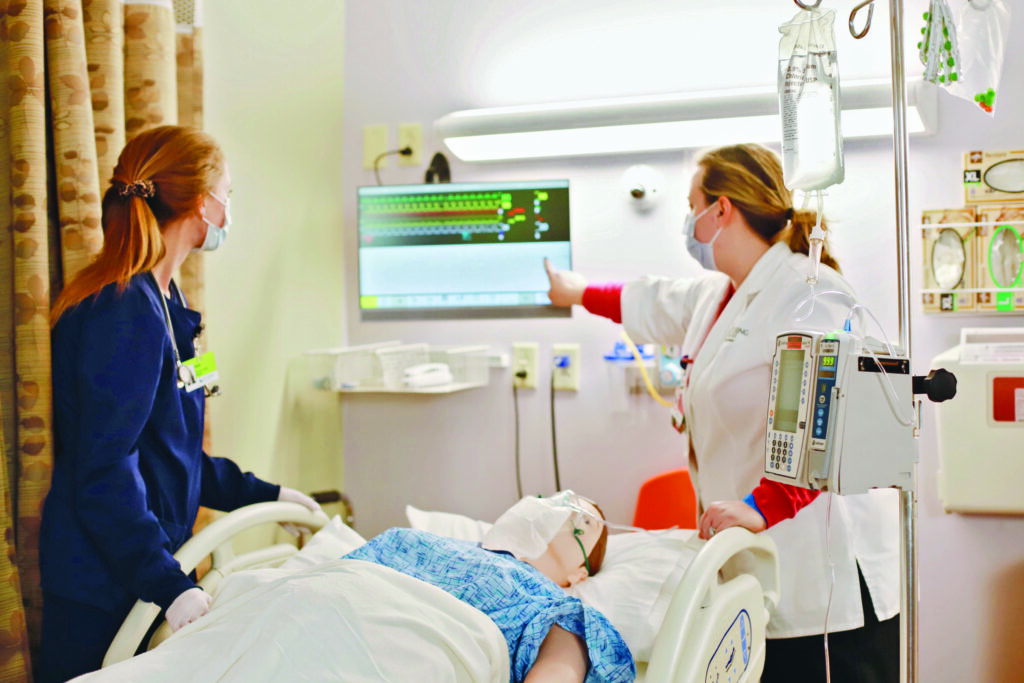
Kettering College has added a new accelerated degree program to help address the region’s nursing shortage.
